


The Roosevelt House is a fantastic piece of architecture with a supremely interesting history. The auditorium is vaulted and holds about 60 nerds at any given time, mostly people who willingly traveled to Midtown Eastish for a 4-hour, half-day conference where 12-15 experts in various fields came together in panels of four to extol the virtues of autonomous vehicles; or to excoriate the false premises; or to bring reasonable and measured concerns about their futures. I learned almost everything I ever wanted to know, which, as it turns out, was like cracking and then uncracking an egg.
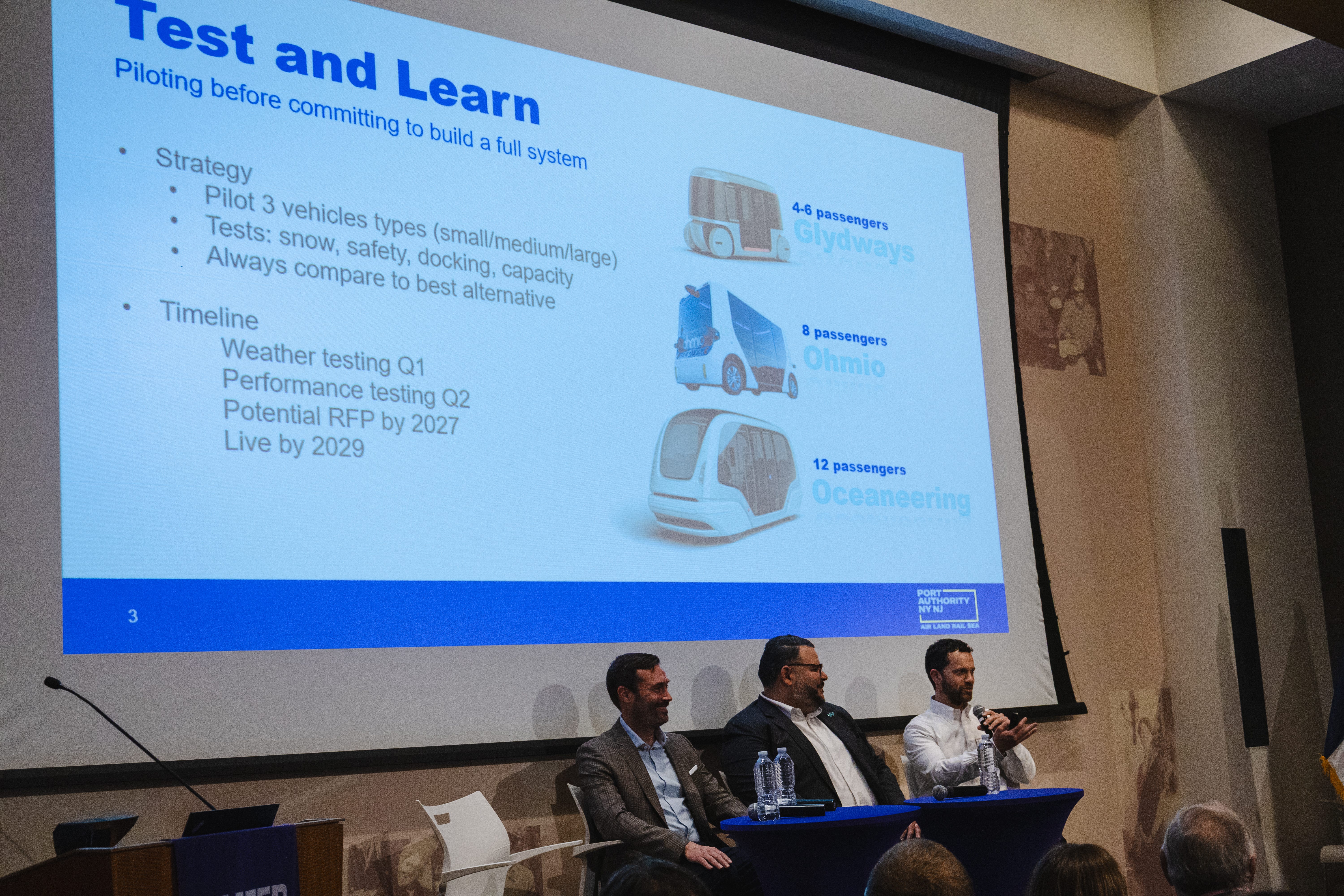
First, the crack: the drop from 30,000 feet. “Session 1: The State of the Autonomous Vehicle Industry — Promise, Reality, and Readiness,” hosted four storytellers from the public and private sectors. Next, the gather: the reality check from the skeptics who have been shouting into the vacuum. “Session 2: Autonomous Vehicles and the Hard Problems — Safety, Streets, and Tradeoffs,” wrestled with tough questions without a response. I’ll get into what I found out here. Last, the ikigai: soldering the pieces back together with a reality check. “Session 3: Panel 3: Moving Forward — Governing Autonomous Vehicles in New York City” dug into the thorny, less obvious challenges facing those seeking to regulate AVs as they roll around city streets. All three together and, well, that’s all you need to know for now. Seriously.
What I Expected: I’m going to reflect on what I expected before the session, knowing full well that this is a silly task given that I’ve already seen the session and all the subsequent ones. Think of this more like discussion questions.
What I Learned: What are my takeaways from this session? What confounded my expectations? What’s a nugget or tidbit that will help you do better in thinking about AVs holistically?
Sam’s Note: My reactions to what I learned, interspersed where appropriate.
Odds’n’Ends: Funny or poignant comments made that don’t really fit into other categories.
Session 1: The State of the Autonomous Vehicle Industry — Promise, Reality, and Readiness
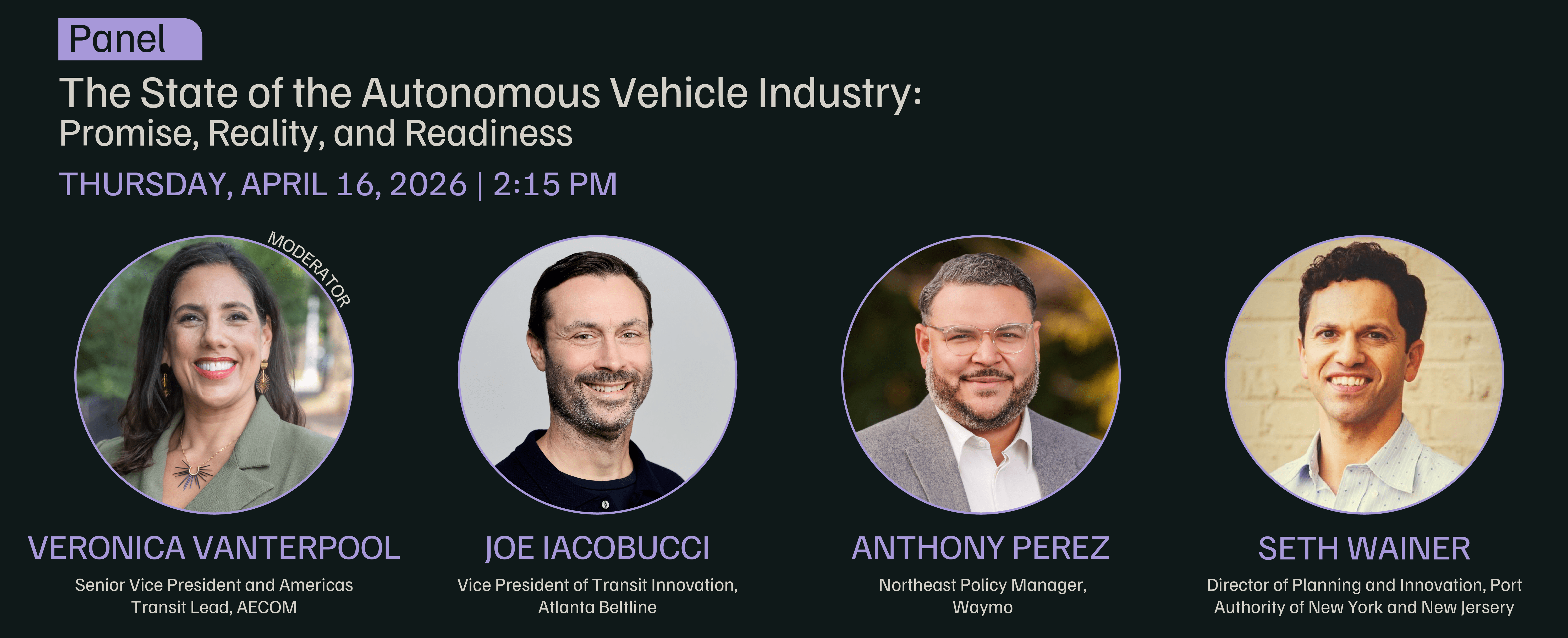
Joe Iacobucci, Vice President of Transit Innovation at Atlanta Beltline
Anthony Perez, Northeast Policy Manager at Waymo
Seth Wainer, Director of Planning and Innovation at PANYNJ
Moderated by Veronica Vanterpool, Senior Vice President and Americas Transit Lead at AECOM
What I Expected:
Some industry shilling and salesmanship from project/agency representation—not that this is a bad thing necessarily. I think the public sector should be trying to sell us their ideas as often as possible, and the purpose of the private sector is to sell its wares, goods, and services. I expected all parties to show & tell their bona fides and for this discussion to be less critical and more spin than deep learning.
What I Learned:
Less than I should have, but more than I thought I was going to. Here’s what I mean: these panelists were cagey and very much on party lines. I’m not saying this was necessarily a net negative—it’s to be expected, and it was great to have these different perspectives on stage together. I’m going to paraphrase, mostly below, except where I’ve surrounded the text in quotation marks.
When asked, “What are AVs doing successfully today that they weren’t doing 5 years ago?” is an interesting question from Veronica.
Seth: They can detect crash markers much quicker—something traditional transit can’t necessarily do.
Joe: Many automated public transit vehicles are purpose-built for the use case and not retrofitted with existing equipment.
Anthony: Waymo operates in different cities with different challenges, but the vehicles themselves are equipped with LIDAR detectors that … self-clean.
Sam note: this is extremely interesting. Not necessarily the actual point about the LIDAR detectors, but rather the minutiae that often get lost in the bigger sauce of operations and design. What else aren’t we thinking about as practitioners and skeptics?
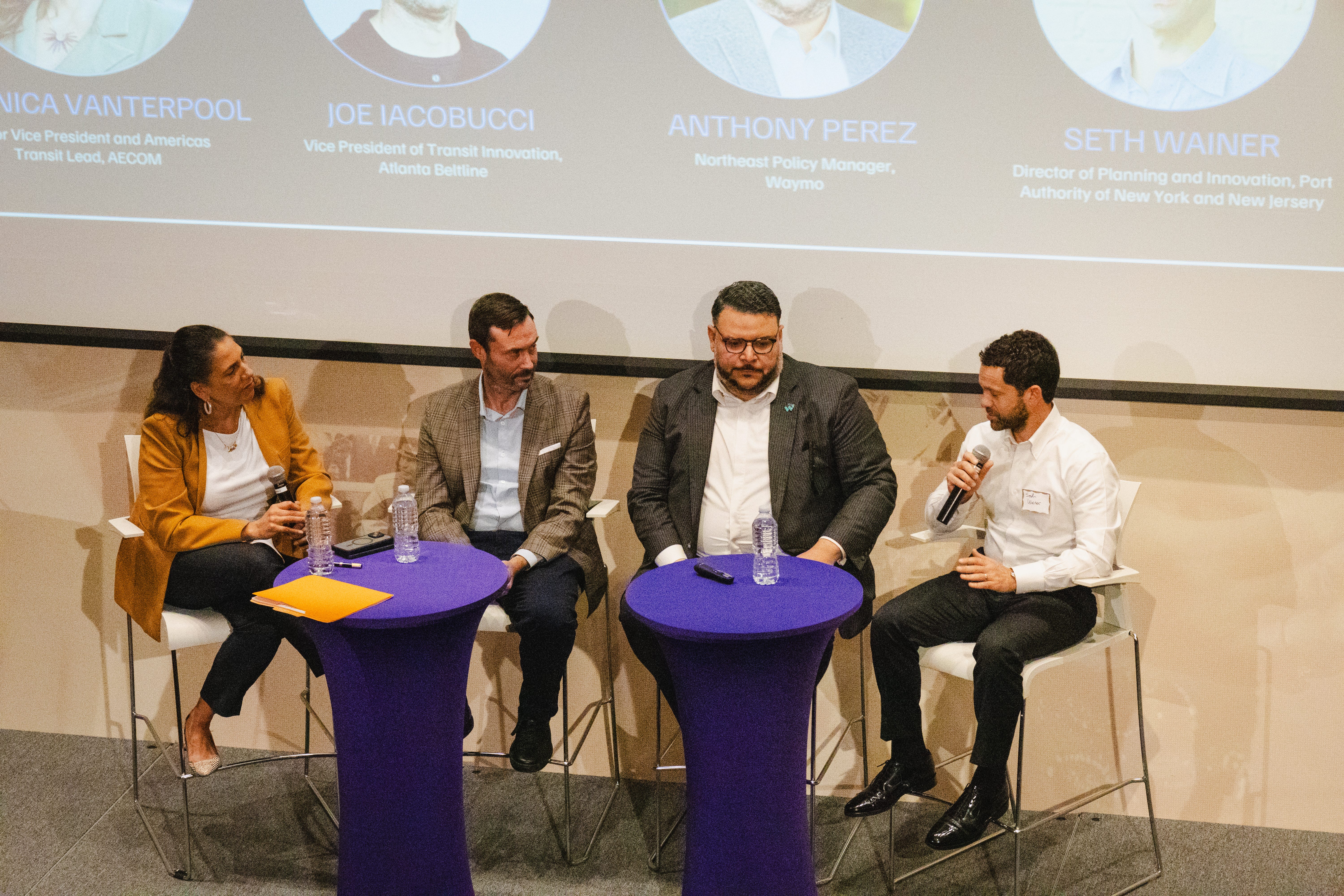
When asked, “What does policy look like?”
Joe: Focus on outreach around a pilot project. What does a project’s particulars actually look like? If it is determined that the demand might work differently in a retail environment, why not shift the operating hours to a noon-to-night schedule from bankers’ hours? Nothing is set in stone.
Seth: How do you translate the “cool factor” to public transit to get buy-in to move people in big numbers in big cities?
Anthony: Car readiness is more important. It’s up to Waymo to work with the conditions offered and design a solution. Once launched, the next phase is how to make the rollout better.
Sam’s note: all three of these are mostly terrific, and Anthony’s note about the Waymo approach got me thinking. It seems that Waymo, as a private provider, can be flexible. In states that demand less, Waymo can give less, and in states that demand more…well, you can figure this out. At what point does the private actor actually dictate policy from experience? And who in the government can say yes or no with an information asymmetry as pronounced as we’re expecting it to be?
A great question from Veronica: “What guardrails are needed to improve access rather than to simply reinforce gaps” in the ecosystem?
Joe: Services offered should mimic public transit’s offerings: affordable, equitable, sustainable.
Anthony: Waymo’s role is filling gaps like first and last mile access to transit.
Seth: Make the tech ubiquitous. Why do customers reach for U*er? AV transit needs to be like that.
Sam’s note: I don’t buy much of this. All the points here lead me to believe that we should be tripling down on transit in most forms. When these panelists say we should look to mimic transit’s benefits, all I can think of is, well, we can with…transit. Maybe the propulsion and navigation changes, but at its core, transit is moving the masses, AV or not.
Veronica asked: “What lessons have we learned from early pilots, from risk management, to procurements and partnerships?”
Seth: We have to isolate one question at a time [semi-humorously]: what impossible thing do you want to do? Then go do it. Then repeat.
Anthony: We want to be boring, and we want people to feel like taking an AV is a normal activity.
Joe: Every service must meet the customer’s expectations. But so far, there’s lots of tailwind to push the projects forward.
Sam’s note: Nothing too out-of-the-ordinary here. But:
“What advice do you have for cities to be ‘AV-ready’ within 2 years?”
Seth: Decide what you want to do and then do that thing.
Anthony: We’re advocating in Albany to help create a scheme for the introduction of AVs, and…cities shouldn’t put their heads in the sand.
Joe: Make sure you’re opening a big tent. “It has a thousand parents…be polyamorous.”
Sam’s note: I’m left feeling like I’ve got half the story (or a third, as it were). It is helpful that the program started with this panel, so that audience members of different persuasions and knowledge levels could get some level-setting. It is also curious the make-up of this panel, priming us with industry and application before the reflexiveness of the next panels’ hesitancy toward opening the flood gates.
Odds’n’Ends: I’m left feeling hopeful for this technology’s use cases in cities, as part of certain solutions, and that the private sector might be the best provider generally, with strong regulatory frameworks from the public sector, which has the interests of the public front and center. I don’t know, though, at this point, whether I’m being sold a bill of goods or not. I’m naturally skeptical.
Also, Joe mentioned an organization called the “ACES Coalition”: Automatic, Connected, Electric, Shared. You can learn more about this organization here. I liked what I read from them. Educational and clear legislative priorities. Pro-tip (usually): you can find an index of organizations that are involved in this type of work and…reach out to people if you’re more interested. It’s a mercury vapor lamp for networking. (See more here.)
Very much looking forward to the rest of this series!
As a Regenerative Travel Practitioner, I am watching the AV progression closely. So many benefits to tourists who only understand a money driven industry. True travelers note the absence of consideration for the Communities living with these wandering menaces, and the extraction of jobs (Comvmerce) for every single vehicle out there. True Travelers want a local human driving the car, it's part of our experience (Culture) and how we get to know the place. Yet, forthe Conservation of our environment, of course, the EV is already doing its part of the job in the tourism industry. The next Travel Genius will simply design a AV with the option to chose a human driver in the front and watch travelers choices.