


I’ve written two posts about how to read and think about urbanism like me if that’s at all something you’re interested in doing. It’s been nearly two years since I started this newsletter and there’ve been quite a few new books that I’ve added to my repertoire.
I’ve also decided to include great podcasts that I love to listen to—some of us are more auditory learners and these should be taken into account as we slide gracefully into 2022.
The key point here is that this field is constantly evolving and with more information and with more time we’ll update the way we think, as we should. First, let’s revisit my “Core Four,” for any new readers and veterans alike.
The Core Four
If I were ever to teach a class on urbanism these four would be the books I would assign. (2021 update, this is still true.)
City Power: Urban Governance in a Global Age by Richard Schragger (2016)
If there’s one book, a single piece of critical analysis of how cities work and how players are incentivized to destroy each other in the tumble to the cheapest, it’s City Power. You can stop here if you’re short on time. But read it twice. If you’ve ever wondered why Amazon got 286 applications for HQ2 but (not-so) curiously chose New York and DC, this book has the answers you need.
» Check out the book talk I did with Professor Schragger! «

All That Is Solid Melts Into Air by Marshall Berman (1988)
Here’s the rub with this one. Humans have this innate, probably biological, desire to build, seemingly no matter what. I’m not going to explicitly say, right here, that the answer is the curse and blessing of globalized capitalism. This book asks you to frame how you think through the eyes of Goethe’s Dr. Faustus as if he were a Soviet staring down the Nevsky Prospect in St. Petersberg. Also, one of the all-time dunks on Robert Moses. If you want to know why we can’t figure out infrastructure (or housing, or schools) in the US, read this.
» I still believe all these tenets, but the gridlock that surrounds the ideas has only gotten cloudier. If Berman were still with us, I’d love to see an additional essay about the corruptive nature of Being Extremely Online. The closest analog/thinker we have, I think, is Jaron Lanier. «
The Invention of Brownstone Brooklyn by Suleiman Osman (2011)
Osman’s book is so rich with detail and convincing arguments that everything you thought you knew about gentrification is likely based on a false narrative that you, yourself, created. Daniel Kay Hertz sums it up nicely, here: “And this is where, finally, we get to what it means to love people but hate the public.” (This is not unlike K’s quote from Men in Black: “A person is smart. People are dumb, panicky dangerous animals and you know it.”) Osman’s book, if you read it closely enough, will hopefully strip away any idealism you have left about who’s right and who’s wrong when talking about housing, planning’s stickiest subject.
» It’s continuously helpful to understand that no matter the nature of markets and demand, there will always be actors who cannot square the principal/agent problem. Namely that we don’t make decisions in a bubble, if at all. «
Story: Substance, Structure, Style and the Principles of Screenwriting by Robert McKee (1997)
Here’s where Alex and I differ; I just think communications theory is higher up on my list of things planners and people who talk about cities out loud should focus on. Because here’s the thing: no one cares about who’s right or not, and no one cares about your data. Both of those matter very little if you’re unable to craft a narrative that carries the full weight of your convictions. Learn the principles to tell a story to your audience and your practice will fall in line. McKee’s book is the Great Hack. Don’t worry that it’s for screenwriters.
» I still believe this, and I’ve thought a lot more about structure recently, expanding on the what of narrative. Two thinkers come to mind: Kurt Vonnegut (of Cat’s Cradle & Slaughterhouse-Five fame) and Dan Harmon (of Community & Rick and Morty notoriety). Here’s some helpful graphics.
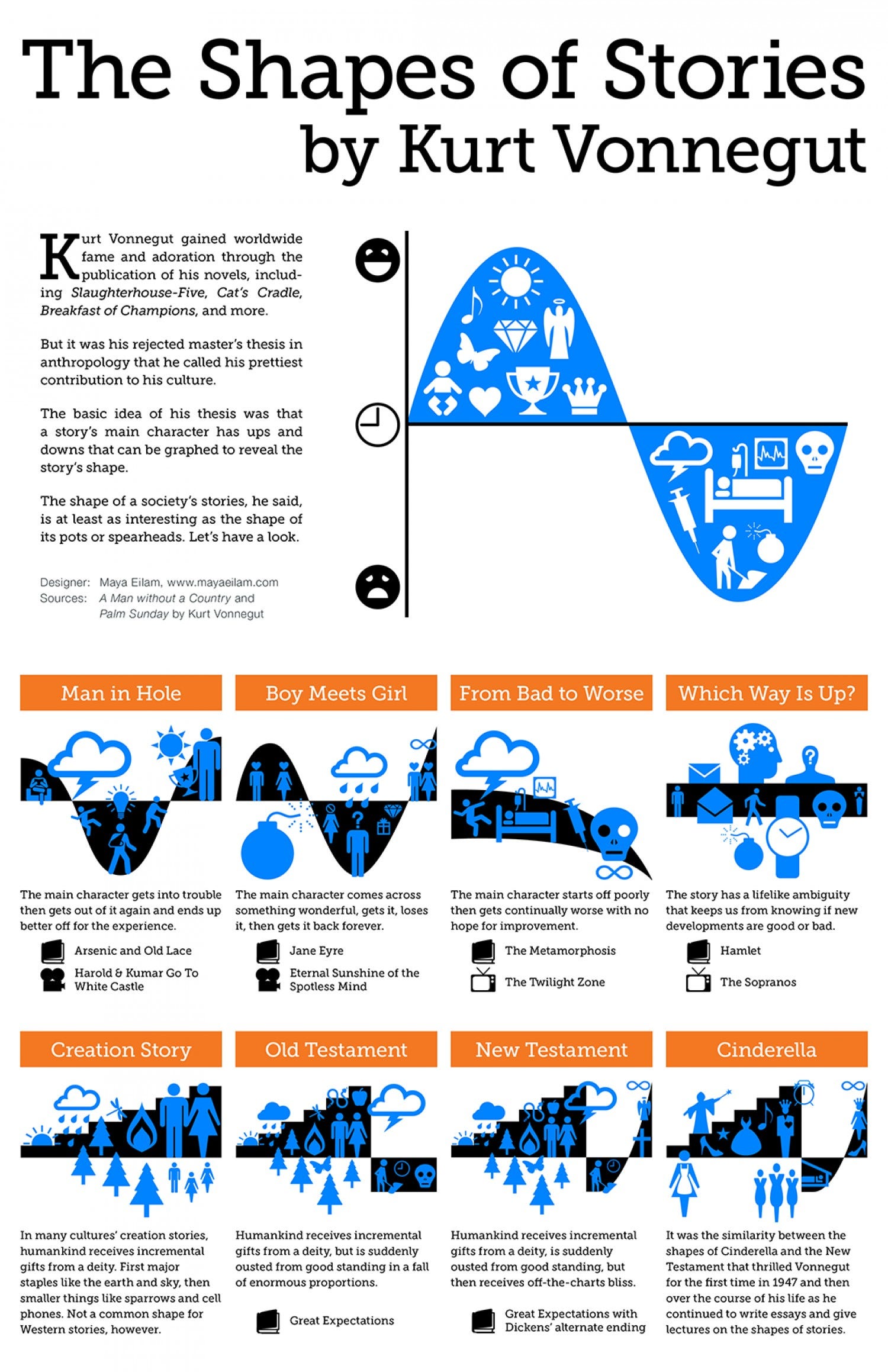
I think we’ve got a lot to learn from Vonnegut to assess certain planning narratives. Can you think of any project narratives that have followed any of the above stories? The Big Dig? High-Speed Rail in the US? Highway boondoggles? Zoning reform?
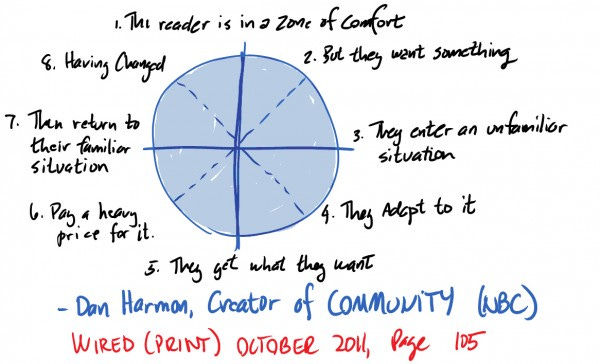
Planning and engagement is a mix of narrative/story and data/information, and I think Harmon’s narrative follows a traditional pattern of preservation planning. We’re hardwired into the 8-step circle for change, except instead I see lots more uncertainty, especially around points 1, 3, 5, and 8. What do I mean?
1: The reader (in this case, the planner, or the community member, or the stakeholder, take your pick) is often not in a zone of comfort. There’s a reason we’re trying to impose our will on the natural entropy of market dynamics.
3: What we know, as planners and change agents or ferrypeople is that the situations we find ourselves in are nominally familiar, with shades of local context. The unfamiliarity comes with new wrenches thrown from evanescent political behavior.
5: We never get what we want. But then how do we progress at all? Incremental changes. But what if the increments are a huge lift for no reward? Why plan at all? This is my existential crisis.
8: How do we measure this change? In a fictional narrative, we can create it; in real life, it’s a lot more nebulous, especially if we don’t know who we’re affecting.
Anyway, here’s the list.
THE BOOKS
The City Is Not A Computer: Other Urban Intelligences by Shannon Mattern (2021)
Professor Mattern asks us to reevaluate what we mean when we talk about “smart cities” and points of interest as nodes of a dehumanized city. Is this a future we want—progress for the sake of efficiency? Why don’t we want the messiness?
People before Highways: Boston Activists, Urban Planners, and a New Movement for City Making by Karilyn Crockett (2018)
This Boston-specific book asks us to look under the hood over a (still ongoing) fight to open the city’s limited land resources to uses other than highways. It’s an almanac to the history of the freeway revolts, with a lens on state law and community activism, and how they mix and don’t.
Bicycle/Race: Transportation, Culture, & Resistance by Adonia Lugo (2018)
Professor Lugo leads us through an autobiographical journey of how she connected and reconnected with her love for the bicycle as a means of transportation, justice, and history. This compelling narrative is equally informative, teaching about indigenous history and great examples from across the world about cycling and how it can be harnessed for righting centuries of wrong.
Slices and Lumps: Division and Aggregation in Law and Life by Lee Anne Fennell (2019)
Fennell’s book changed the way I think about projects and how the parts and the sum are equal in name only, and process is highly context-specific. A great read to help understand that putting one foot in front of the other is sometimes better than diving right in, but also diving in headfirst is sometimes preferable to feet-first.
Mega-Projects: The Changing Politics of Urban Public Investment by Alan Altshuler and David Luberoff (2003) OR
Megaprojects and Risk: An Anatomy of Ambition by Bent Flyvbjerg, Nils Bruzelius, and Werner Rothengatter (2003)
Related to Fennell’s book, either one of these gives us a deep look inside US and global “megaprojects.” What is a “megaproject” and must we—must we—continue to terraform to make people’s lives “better?” What does that mean? At what cost. Either/Or to the above books, but really, read both.
Policing the Open Road: How Cars Transformed American Freedom by Sarah Seo (2019)
This book is the best book I read in 2021 because the approach is so novel. The thesis is this: before the States started to build around getting cars to move as fast as possible, professional policing was rare. As soon as we—we?—decided that car dominance was the de facto goal, professional, pervasive police power came with it. The car conflagration started with a cinder.
Before The Storm (2001) & Nixonland (2008) & The Invisible Bridge (2014) & Reaganland (2020) by Rick Perlstein
These four books by Rick Perlstein are a must-read to understand the 20th-century conservative movement in seismic proportions. Combine with Dark Money by Jane Mayer (2016) and you’ve got the north arrow pointed in the right direction (north).
So Much to Do: A Full Life of Business, Politics, and Confronting Fiscal Crises by Richard Ravitch (2014)
This is a genius book by a genius politician and, in my opinion, the spiritual successor to The Power Broker by Robert Caro (1974). Whether you like Ravitch or not, the anecdotes he presents here are gold for planning enthusiasts with a twist of public policy and, ultimately, politics.
Railtown: The Fight for the Los Angeles Metro Rail and the Future of the City by Ethan Elkind (2014)
A geographical analog to lots of other regional rail/development stories, LA is different because it’s a lumpy, dense, and spare urban metropolis/suburb. (It’s its own suburb?) Where’s the fight? Who are the players and actors? What are their needs and provocations? How does it work differently in California than in Massachusetts?
City Making: Building Communities without Building Walls by Gerald Frug (2001)
This book is not a casual read and it likely takes a law degree or a close read to really understand it. Some books talk about the economic entity that is a city; some talk about the cultural phenomenon; Frug talks about the city as a legal object, for several hundred pages. I’ve had to read and reread chapters and I still don’t totally understand it. But, like Robert Moses, to be the very best at city building we have to understand the rules that allow it to suspend on the land.
Retrofitting Suburbia by Ellen Dunham-Jones (2001) & Case Studies in Retrofitting Suburbia: Urban Design Strategies for Urgent Challenges by Ellen Dunham-Jones and June Williamson (2021)
This is a bible of sorts. Decades of sprawl have come to a head—environmentally and fiscally—and have led us to rethink how we want to infill. For whom do we build and rebuild? How do we look at relics of our past as tools for our future and not total lost causes? Read both and marvel at these ideas.
THE PODCASTS
I’m often exhausted before I start my morning these days and even listening to podcasts takes an immense amount of mental energy. I’m open to ideas from my readers about how they get the most out of their podcasting experiences and recommendations.
It’s about seeing what’s there, but just under the surface. Lots of planning, but it’s a hodgepodge. There’s a book, too.

Talking Headways: A Streetsblog Podcast
The most complete transportation-focused podcast out there.
This one’s engineering-focused and worth listening to, to get a fuller perspective of what transportation planning/engineering is all about.
This is my favorite magazine, content, and design-wise. This podcast leans more elite than the others, but sometimes it’s helpful to hear best-case ideas.

KunstlerCast - Suburban Sprawl: A Tragic Comedy
James Howard Kunstler is an author and urbanist who came to prominence alongside Ellen Dunham-Jones’s ideas of suburbia and the future of the non-hyper-urban. Great, relaxing podcast with different authors than you might normally
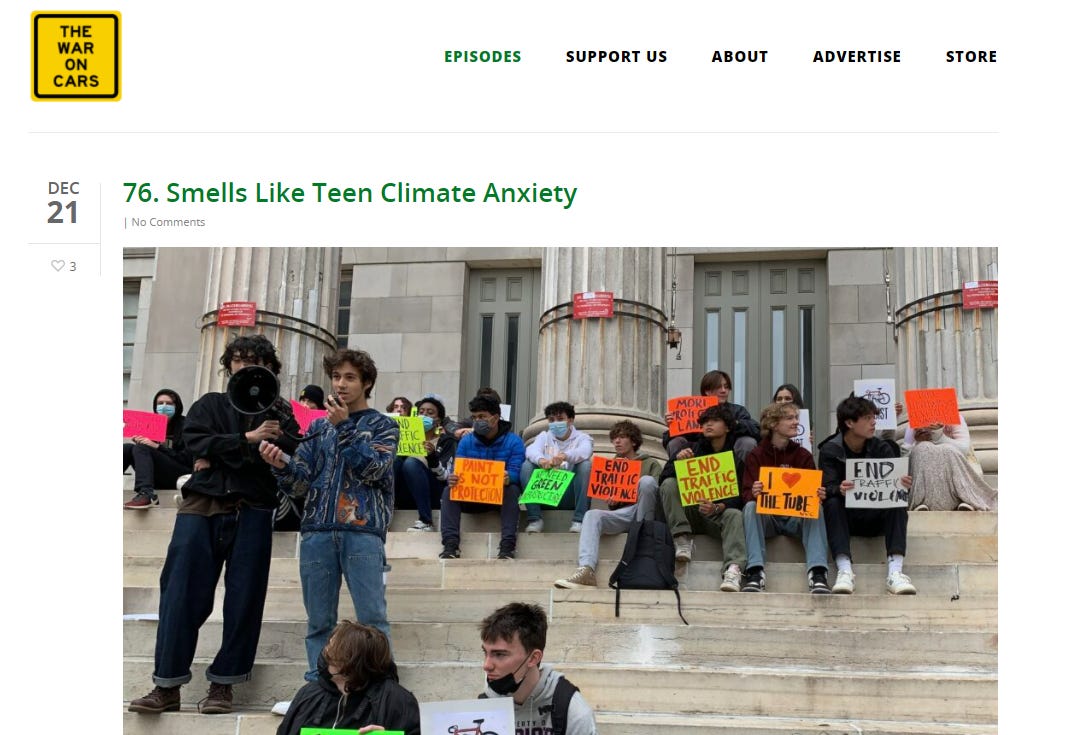
This is a favorite of mine—Doug Gordon, Sarah Goodyear, and Aaron Naparstek’s War on Cars—is a long-running podcast with the semi-explicit goal of ending car supremacy. It’s going, slowly but surely. These are fun, informative lessons here.
It’s a tech-forward podcast from a friend of the newsletter, Greg Rogers, and his co-hosts, Gregory Rodriguez and Pete Gould. These three hosts have an excellent rapport and have several live episodes under their belts, which makes this pod one of my absolute favorites.
Let’s talk about your favorite books. Always happy to learn what my readers are thinking!