


Relive Session 2 Below:

Law is Law. Policy is Policy. Diamonds are Forever.
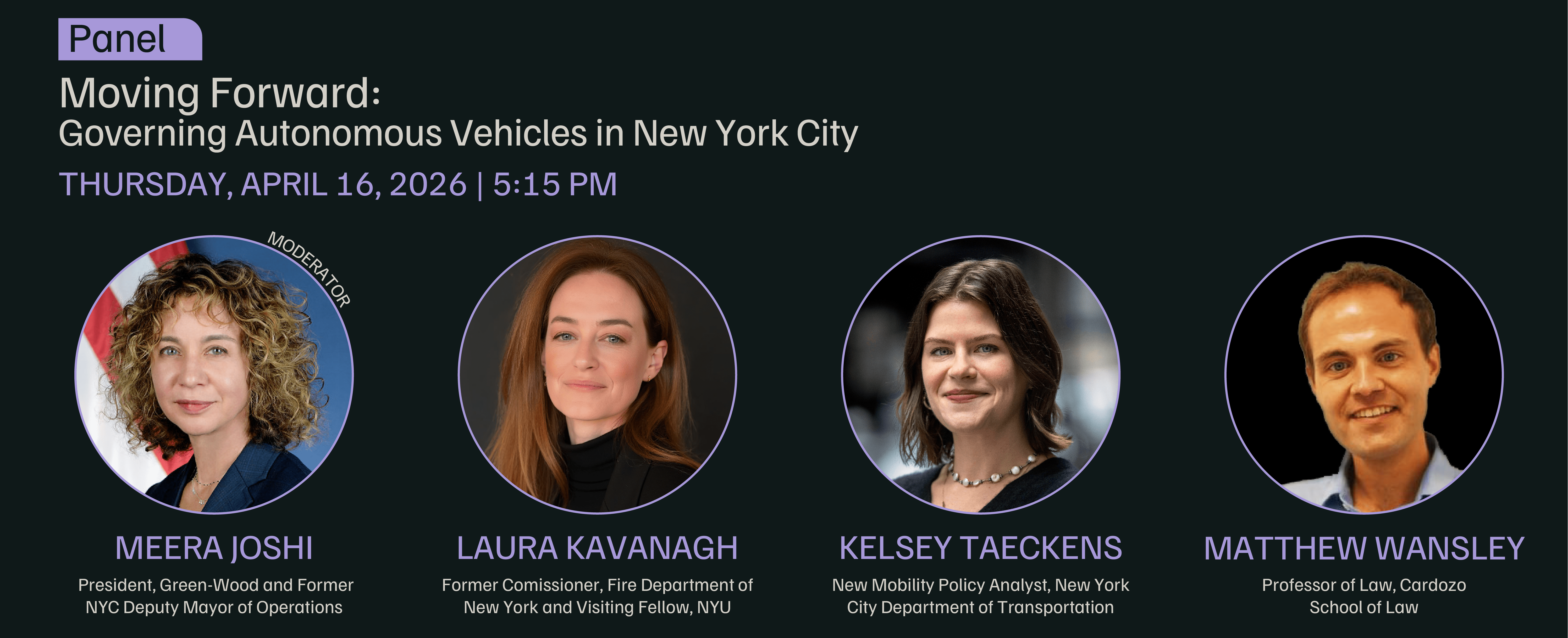
Laura Kavanagh, former FDNY Commissioner and Visiting Fellow at NYU
Kelsey Taeckens, Policy Analyst at New York City Department of Transportation
Matthew T. Wansley, Professor of Law at Cardozo School of Law
Moderated by Meera Joshi, President of Green-Wood and Former NYC Deputy Mayor of Operations
What I Expected:
A measured balance between the boosters and the skeptics. This session’s panelists treated AVs as not inevitable but probable and crafted their responses accordingly. Where are the gaps? How do we regulate this tech—is it fundamentally different than other mobility tech, or do our boosters say it is to claim a new vertical? Either way, we’re entering some uncharted territory, but we can certainly apply first principles to AVs to make sure the actors play nice. Safety and security were likely big themes to address here.
What I Learned:
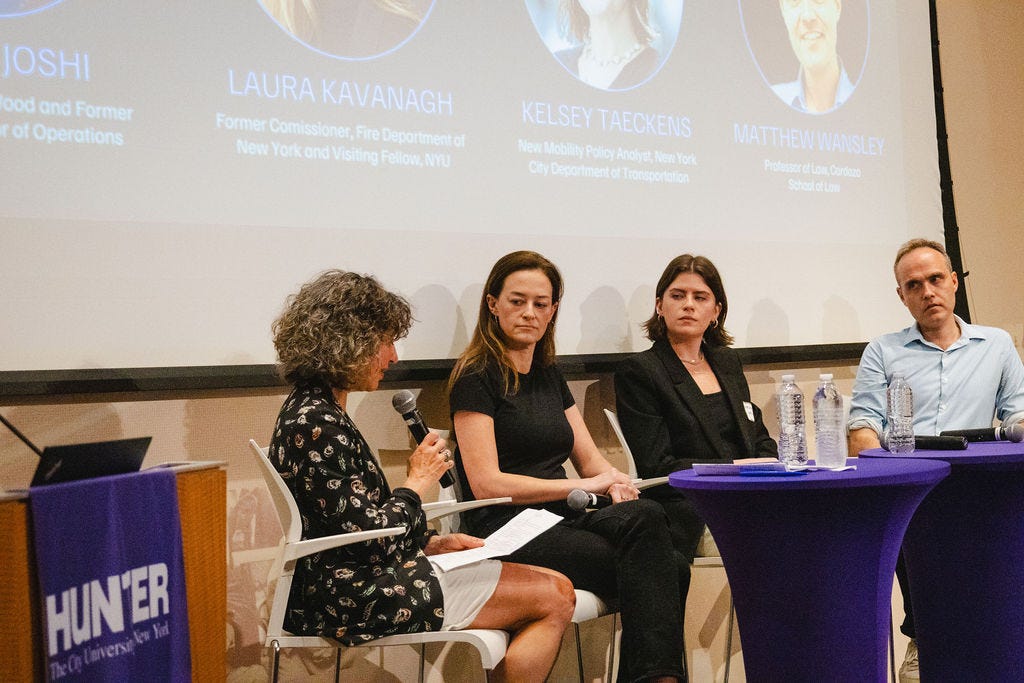
Moderator Meera Joshi leapt right in: “How do we enforce ‘safety’ in the public-safety-decisions-making environment?”
Laura: FDNY operates in conditions where things fail. Public agencies are looking for failure conditions not to criticize but to understand how to respond.
Kelsey: What are we doing already? Is the technology safe enough to operate on our streets? That’s step one. Step two: is the worker protection question. We must answer the questions from the 180,000 TLC drivers. Is NYC different? We have the most complex street system in the county/world — it does look different than Phoenix, etc., and we don’t want to be the place where the operators are discovering new problems.
Matthew: There is a massive amount of data available via NHTSA’s Standing General Order (SGO) on Crash Reporting mandate. Every crash involving an AV will be on this database. The Trump Administration watered it down (type of injury, vulnerable road user binary, less than $1k property damage). About saving lives? AV crash rates are lower than human-powered. Human crashes are underreported, and at least the data protocol is helping because we know about underreporting.
Sam’s note: These three points are already excellent separately, but together they tell the entire story of public procurement, or at least the 21st-century rotten, ninth level of hell version of it:
Public sector partner says no or hold on even a second, and gets castigated as anti-progress. Safety is key? Please
Public sector partner asks questions about the public interest and labor (which always seems to get last looks (duh (it’s capitalism))). Asking not to be a natural experiment so capital can run amok is apparently bad?
Duck and cover behind data to prove a point one way or another.
Capital wins.
Meera with a colorful question: “Is NYC government an ‘octopus?’ We need one voice on this. Who should be the leader, and what takes precedent? Beyond safety, what benefits are we looking for? They say Manhattan streets are paved with gold—there’s constant demand for quick movement of people and goods with very little price sensitivity.”
Laura: Someone was told they were it, and they were forced to do it. We need to get everyone to the table and value their opinion (not necessarily equally). Don’t shut down a complaint—run it into the ground. What is the world where we’re saying we can’t? The complaint will move forward without us, and that’s terrifying.
Matthew [deep breath]: There’s a red state / blue state divide. With red states, there’s this laissez-faire approach: we can’t regulate it in any way, drivers should just follow existing traffic laws. With blue states, there’s a NIMBY approach: instead of regulating, we hope the tech will…go away. Regulation should focus on curbing externalities, protecting consumers, and changing the built environment with congestion taxes.
Privacy is important, and there’s not enough conversation about passive surveillance. So far, there’s little regulation that limits what companies can do with that collected data or work with local law enforcement without a court order. I’m worried about a monopoly when the competition is intermodal. There needs to be competition in the robotaxi market to ensure consumer protection. If none exists, we need regulation to mirror what competition would do. Regarding preparation for emergencies, regulators hadn’t prepared by stress testing Waymo’s response. Really, cities need to get rid of parking on streets and replace it with more room for pedestrians, cyclists, and development, but that can’t happen alone. We need Federal, state, and local policy to align (Ed: who does what?).
Sam’s note: Okay, big deep breath. Matthew’s paragraph mimics what it felt like to sit there and listen to a half dozen good ideas at once. The key takeaway in there is the idea that regulation should focus on curbing externalities: where do we anticipate challenges with AV operations that don’t resolve in the “market?” Regulation should focus on assigning the correct response to arbitrage: namely, monopoly pricing power and congestion. A car is still a car is still a car. And monopolistic pricing distortion isn’t magically different because we’re talking about transportation. Inb4, but what about Amtrak: that’s a natural monopoly. Should we nationalize rail? Is that right?
More table setting from Meera: “What do we do when things go wrong? Who is ultimately responsible so our providers don’t play hot potato with blame or hide inside a shell game?”
Laura: Establish guidelines now. Make the firms comply with local rules before they come. We shouldn’t have to call them to beg for data. It needs to be more prophylactic and rational.
Kelsey: We need a way to ticket a vehicle without a driver. Who’s providing the data? The OEM, the vehicle manufacturer, the fleet manager, the vehicle owner?
Matthew [deeeeeeep breath]: Three ways: Liability and private lawsuits (tort law), traffic law (state and local), and regulator responses to safety incidents (Federal). The liability standard for L4 autonomy is clear: if you get into a crash with a Waymo, you can file a lawsuit. Did this car deviate from consumer expectations? This is also very different from Tesla Full Self-Driving [(Supervised)]: Tesla has a driver assistance system, and Tesla has pinned responsibility for crashes on the “driver.” For traffic law, California didn’t have a way to ticket an AV company…did the state assume that AVs would or could never break traffic laws? Last, regulator responses: NHTSA has used the SGO database to track incidents. Trends could be used to require operators to make changes to software to settle a recall or…
Laura: In government, we found innovation challenging. I didn’t know who to call to “innovate,” especially with science, since we didn’t have scientists on staff.
Mathew: We need more technocratic expertise in government…former Acting Administrator Ann Carlson opened an Office of Automation Safety until it got DOGEd.
Sam’s note: It’s very important to have the basics of the law here. It helps a planner or an urbanist think clearly about how negotiating partners and stakeholders think about the future of automation. While you and I might think about demand and the environment, the lawyers are thinking about liability, and the electeds are thinking about popularity. Empathy for something you don’t believe in is the highest level of ego death. I recommend it.
“What’s the role of a regulator overall? Is it my role to stop ‘progress’ and put a barrier between what people want and a service that can fulfill that need? How do we close the chasm between the need to regulate and what companies will do on their own?” Meera with the mic drop.
Laura: Where do you start? You need some version of access to data in an iterative manner so you can adjust your approach based on new or up-to-date information.
Kelsey: We don’t currently have a Federal framework for vehicle design and safe testing. We don’t need to issue every Toyota a permit because we have regulations and assurances that its brakes will work.
Matthew: There’s the issue of remote “facilitation.” There are centers in Michigan, Arizona, and…the Philippines. Take, for instance, the SF electrical blackout. When one light is out, the car knows it can ping a real person, but the system bricked because of the sheer volume of requests. So if you’re a facilitator in the Philippines…how can we enforce traffic regulations against you? Do we need the San Francisco District Attorney to request the US Department of Justice to reach out to the Philippine government to extradite a particular worker?
Laura: “FDNY doesn’t/can’t/won’t understand” is not acceptable. Waymo uses this as an excuse to get around explaining itself.
Sam’s note: The takeaway here is the box in the lower right—the “unknown unknowns” are plentiful and intersect or interact with one another, and we don’t know how yet. We’ll eventually figure this out, but my hope is twofold: that we don’t use humans as fodder for capital (unlikely) and we don’t run transit out of business.
Odds’n’Ends:
This final panel was the perfect end to a 4-hour lecture series that didn’t quite feel like it. It was packed with learnings and takeaways. None of the 12 presenters was there to pontificate (well, maybe a few), but it did feel like the most candid conversation you could have in a room full of interested advocates, practitioners, academics, and skeptics.
FDNY does themselves no favors (see also their stance towards road diets, bike lanes, any suggestion that they fight heart attacks not fires, etc.)