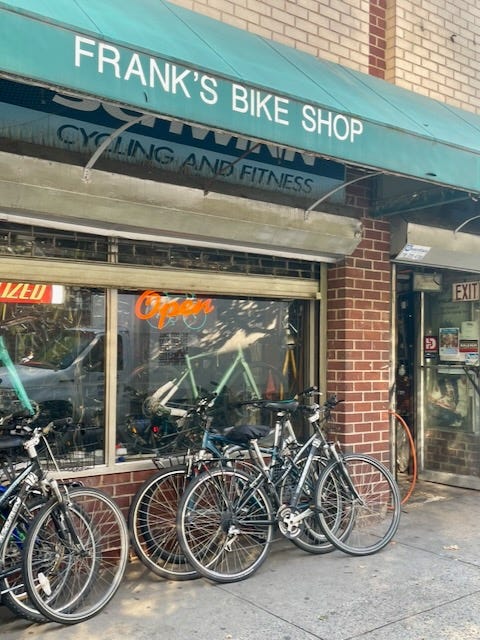
Today I’m pleased to share a guest post from Tricia Davies, a new friend and now Exasperated collaborator. She emailed me and asked if she should publish a few words about a local legend, Frank Arroyo, who owned a bike shop on the Lower East Side for nearly 50(!) years. What follows is a brief biography and a few of Tricia’s smartest thoughts on what you and I can do to help and some sage advice for wannabe small business owners with a heart of steel and nerves of gold.
Remember: not knowing how to spend $1 trillion applies to non-transportation infrastructure, too, and small businesses—and how we get to them—are themselves destinations that make travel worth it.
—Sam
New York City lost a neighborhood icon in December 2025.
Frank Arroyo did more than sell and repair bikes at his eponymous bike shop on Grand Street in lower Manhattan. It was a no-frills shop, packed to the rafters with new and used bikes of all sizes and makes. Open every day except Wednesday.
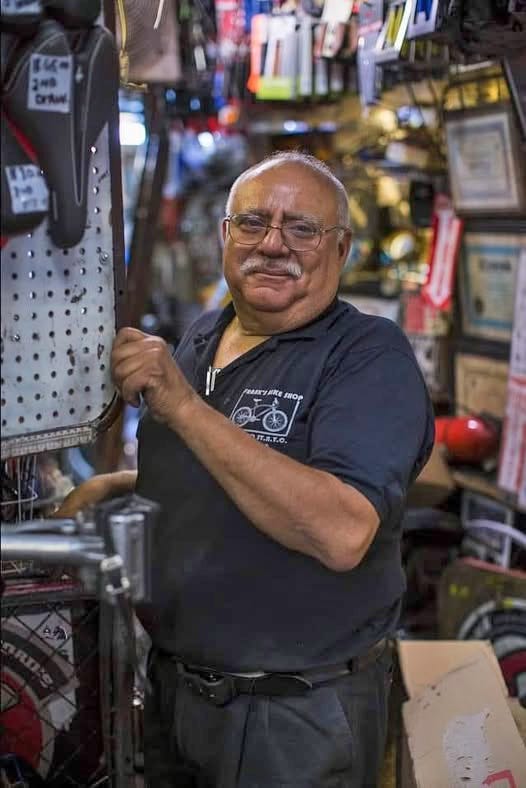
Always dependable, quick, and generous. There were times I’d come by with my old bike in need of a brake adjustment, and he’d wave away the small sum I offered. Dedicated customers drove an hour from New Jersey to have their bikes repaired, or to trade in for a new one. Parents came here for their kid’s first bike and a subsequent trade-in deal years later.
Each year before Christmas, Frank would spend weeks decorating every inch of his shop windows with dioramas of miniature villages with moving trains, bright and sparkling with colorful lights. It was part of the season -even if you didn’t celebrate Christmas, kids and adults stopped by to ooh and ahh.
He was in the shop every day, overseeing his assistant who did quick work on repairs and adjustments, chatting with neighbors and the regular old guys who came by just to sit on the sidewalk with their coffee, watching neighbors pass.
When I noticed the gates shut over the windows and doors when he’d normally be open, a tug pulled at my guts. Not another neighbor out of business! In fact, the gates haven’t opened since December.
A recent report by the Comptroller’s office analyzes storefront vacancies and small business challenges. Their analysis of storefronts from 2020 to 2026 shows that most small businesses that close are actually replaced by new small businesses -not large chains. While shoppers may feel a certain sadness at the loss of large stores such as REI (I was more bereft at the loss of Tent & Trails) or Century21 (that made a recent comeback), it’s the small, independently owned businesses where the owner knows you for real, not through an online algorithm, that we miss the most. These are places that contribute more than money can buy. They add to the neighborhood character with their unique and sometimes quirky flair in the products they sell or how they interact with their customers. Small business owners like Frank have a history or personal passion for what they sell. And as customers, we can tell. Our interactions are more than financial transactions.
I can’t say how much a city should do to spare small businesses. Success or failure depends on so many factors. But when a business has given 50 good years to a neighborhood, taxing it out of existence should not be an option. The City’s Business Improvement Districts offer some help. But if your business, like Frank’s, isn’t located inside a BID’s boundaries, you’re not on their radar. As it stands, the LES BID only covers six blocks of Grand Street, a strip that currently has four vacant storefronts. Besides being outside the BID boundaries, the stretch is about half a mile from the nearest subway station. Larisa Ortiz, an expert on urban retail development, suggests that proximity and accessibility to urban business storefronts for shoppers would improve their survivability.
In August 2025, I stopped by to have my bike checked before bringing it upstate for three weeks. While waiting for Frank to finish with a customer, I overheard him say he didn’t know how much longer he could afford to keep his shop going. He said he was ready to call it quits.
A sudden alarm hit me. The thought of losing a beloved shop that I’ve depended on for 20 years, and its owner, was like breaking a coffee mug gifted by your best friend. Its utility can be replaced but not what it represented. Biking is my transportation, and Frank was always there for us. Turns out, his Commercial Rent Tax (imposed by New York City and not the landlord) cost him $33,000 last year. When he opened the shop in 1976, it was $1,500 (or about $8,800 in today’s dollars). In real terms, the tax he paid to maintain a small storefront had gone up 275%.
Frank was resilient, though. He’d lost his career and economic security years ago through the short-sighted negligence of New York City’s financial stewards. It was 1975 when the City went bankrupt by selling debt it had no means of repaying.
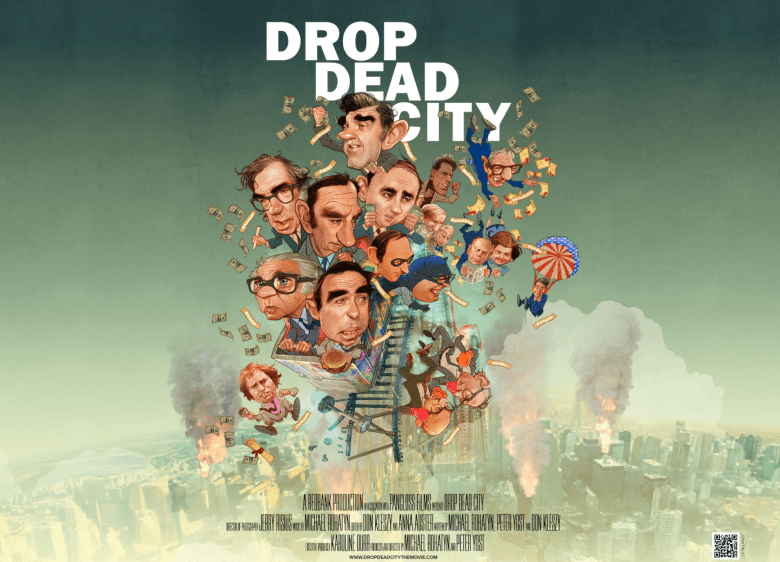
The day before stopping by Frank’s for my bike tune-up that August day, I had been to a screening of Drop Dead City, a documentary that catalogued NYC’s ‘75 egregious fiscal crisis. Scenes from the movie were still coursing in my head; neighborhoods were destroyed, garbage piled up, middle-class workers who the City depended on paid the price: City workers were laid off, overworked firefighters responded to nonstop fires in the Bronx, Harlem and other neighborhoods already on the margins of economic survival. The shock was at how City and State administrators and the banks that enabled it looked away, allowing the disaster to continue unabated for years.
Appalled at the suffocating rise in his rent tax, I had to know more about Frank’s story during this fraught time in the City. So I asked him about the origins of his bike shop in 1976. Turns out, Frank was one of 5,000 police officers who had been laid off by Mayor Ed Beame in 1975 (not a coincidence). He had just completed training with the police academy, followed by three months on the force. Having lost his job, he quickly turned to his personal love: riding and repairing bicycles in the neighborhood where he grew up.
In 1976, the Lower East Side was a lot grittier than it is now, with the highest density of publicly owned or financed housing in New York City. Rent was cheap enough to open the bike shop and acquire a modest inventory. He loved what he did and the neighborhood loved him back. Frank was an honest businessman who genuinely cared about his customers and the neighborhood.
As our city and country make the cost of living a central rallying cry, government leaders must focus on the value that small businesses bring us. Taxing small businesses out of existence or neglecting them when they need help navigating government bureaucracies is short-sighted, considering how much they contribute to community vibrancy and trust. Keeping small businesses alive and thriving, especially those that offer services by trained experts (bike repair) not easily replaced by AI, in a city where there is growth in bike ridership, is good not only for the business owner who knows our name but also for customers in need as well as the overall health of the community.
Not every small business is going to survive the age of online shopping with the convenience of free shipping and low prices made possible by giant retail warehouses.
If we want to keep these small, neighborhood institutions going, there are ways we as consumers and our government policymakers can support them.
Four Ways to Support Small Businesses in 2026
The most obvious is to shop from small businesses. If you’d like to but find it inconvenient (the local shop doesn’t carry the bike saddle or basket you’re looking for) ask if they’d order it for you at the standard retail markup. Independent bookstores can be hard to find. Bookshop is a terrific resource that allows you to order the books you want online while supporting Independent bookstores at the same time.
Small business owners looking for resources or advice should check with NYC Small Business Services to confirm if they are located in one of the City’s 78 BIDs or visit this map of neighborhood development grants. NYC also has a Hotline (888-SBS-4NYC) for small business questions and has just released a plan to simplify and expedite some of the notorious hurdles that certain storefront businesses face. Let’s hope the recommendations are more than that and real action is taken.
Small businesses are often located near other non-competitive businesses that could be looking for creative ways to keep customers coming back within their neighborhood. A deli down the block might be interested in selling coffee or snacks at a slight discount to a bike shop’s customers who are waiting for repairs or returning from an excursion on a rental bike. Shops that offer services (hair and nail salons, bike repairs) might consider teaming with nearby cafes or tea shops to boost each other’s sales and sense of community.
Small storefronts may need to consider revamping their business models to incorporate online sales (something Frank didn’t really do) to stay in business. Considering untapped markets, offering new goods or services that can be supported by expected demand, and new marketing strategies require some time to think creatively and honestly about finances and business goals.
Frank passed away in December 2025, close to 80 years old, the cause of death unknown. And although his initial plan to serve this great City was taken away in 1976, he still got to live out his dream of serving our community for 50 good years.
We miss you, Frank.