


This week I did stuff. I bet you thought in last week’s Mini Exasperation, I was just talking about government, that it’s only New York’s new government that can just go build a thing, but no, it’s you and me, too. You just have to show up.
Here’s what I did.


I showed up for friend-of-Exasperated Infrastructures’ Kathy Park Price’s tour of open space, or lack thereof, in Long Island City. There’s yours truly in the orange coat and backpack. I do look ready for a cold-weather hike. It was 6 degrees Fahrenheit. The tour was part of a larger campaign for the amazing advocacy organization, called New Yorkers for Parks (NY4P), that does exactly what it says on the tin. They research and advocate for parks, and what they don’t say on the tin, they partner with other organizations that care about open space and parks to amplify this message to elected officials, residents, workers, and help give a meaningful voice to the underheard. Don’t ever let anyone tell you your voice doesn’t matter, and don’t ever shy away from being the best version of yourself by just showing up.
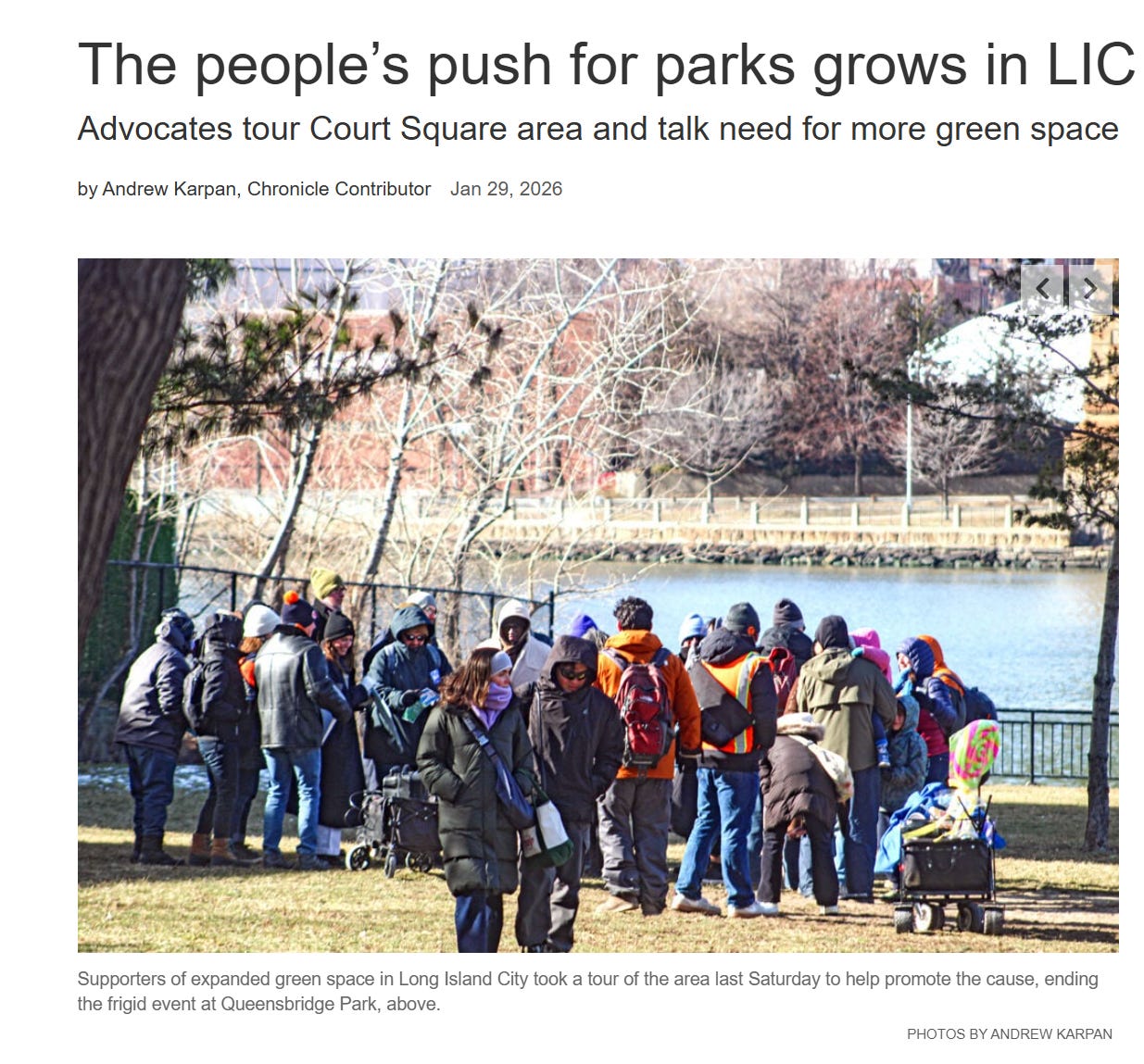
But it doesn’t matter. I showed up—along with dozens of friends and fellow advocates who got the Councilwoman (CM Julie Won) out for a press op, and an article in a widely-circulated local paper. We toured a half dozen sites where there have been new parks built, new parks planned, or new ones needed, and heard from local residents who deserve a place to decompress, connect, and learn with neighbors and friends without having to schlep all the way to elsewhere.
We should be building connected communities, and we should be connecting them with parks and bikeways and friendships.
~*_________________________*~
Last week, I also worked with a delegation from Transportation for Massachusetts to help them understand messaging around congestion pricing1 to eventually help convince Governor Healy et al to pilot it forever around Boston. The contents of this talk were off the record, so I’m not going to post any findings or shared thoughts here about it, but it was really great to be in this room with people DOING STUFF.
DO MORE STUFF.
A Few Small Articles
MUST READ
A Better Billion: Expanding Transit & Housing for a More Affordable New York
by the Transit Costs Project team, including friends of EI, Eric Goldwyn, Andrew Lynch, Nolan Hicks, Alon Levy, Elif Ensari, and Franklin Tang
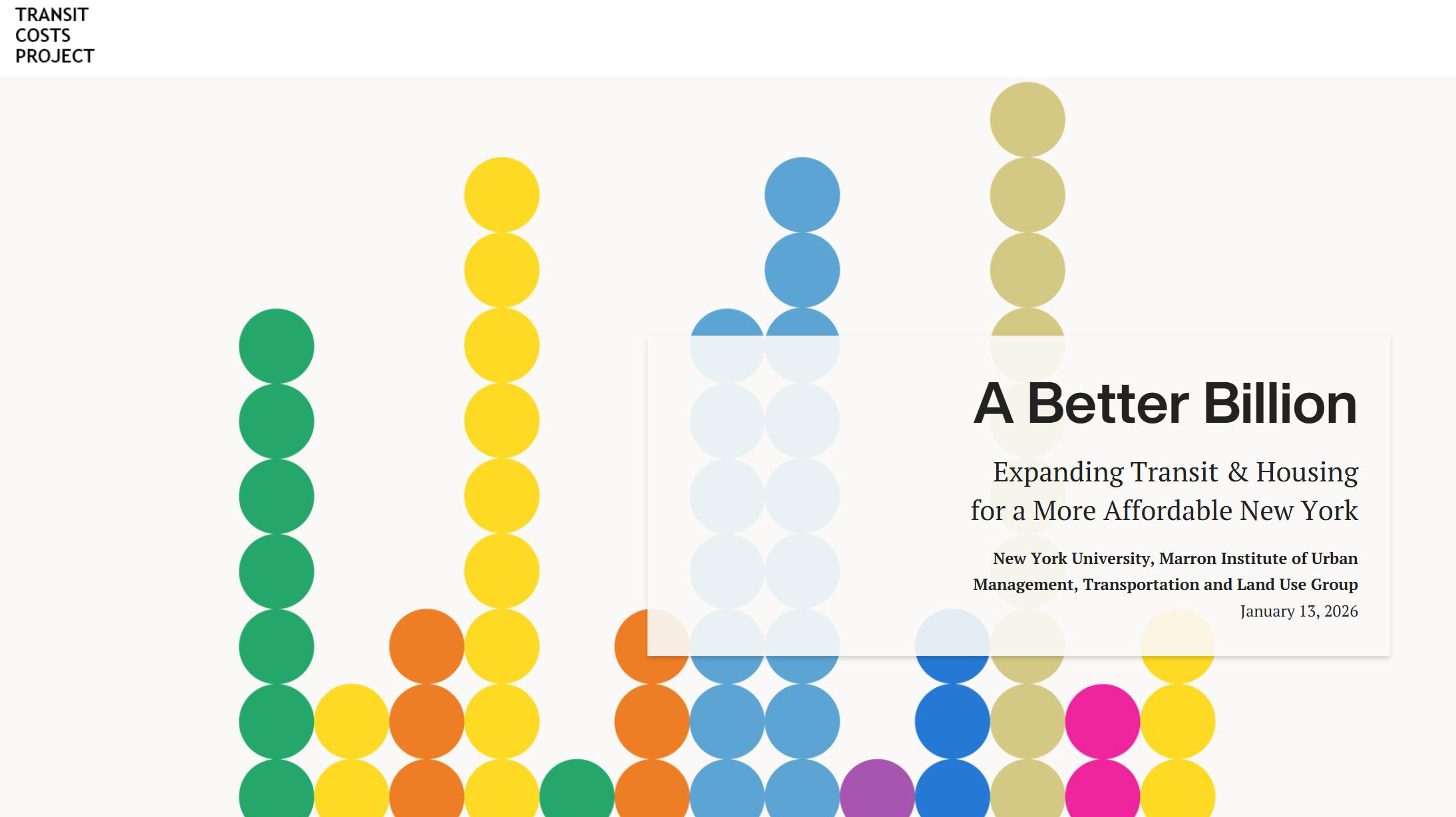
This report is a masterful guide and vision that looks beyond the limited scope of “what if we just made the buses free.2” It reports on what the future of our system could look like under realistic capacity and geometry constraints,3 but holds cost caps relatively loose.4 The point is to have a realistic and, their words, audacious conversation with anyone who will listen about how we move throughout our city.
It’s not audacious to expect less friction in getting around our city. In fact, this is the best possible deal. For a mere 5% of the total cost of the system5—should it be built from scratch today—we (and you if you don’t live here but want to come visit us for our stuff) get 41 miles of new subways, 64 new stations, and an inducement of 167,000 new housing units.
We also get to collectively vision and foam. I’ll do a longer dive on this soon.
Memo to Mamdani: Bring Back the Weekend G Train to Forest Hills
by John Surico for Streetsblog NYC
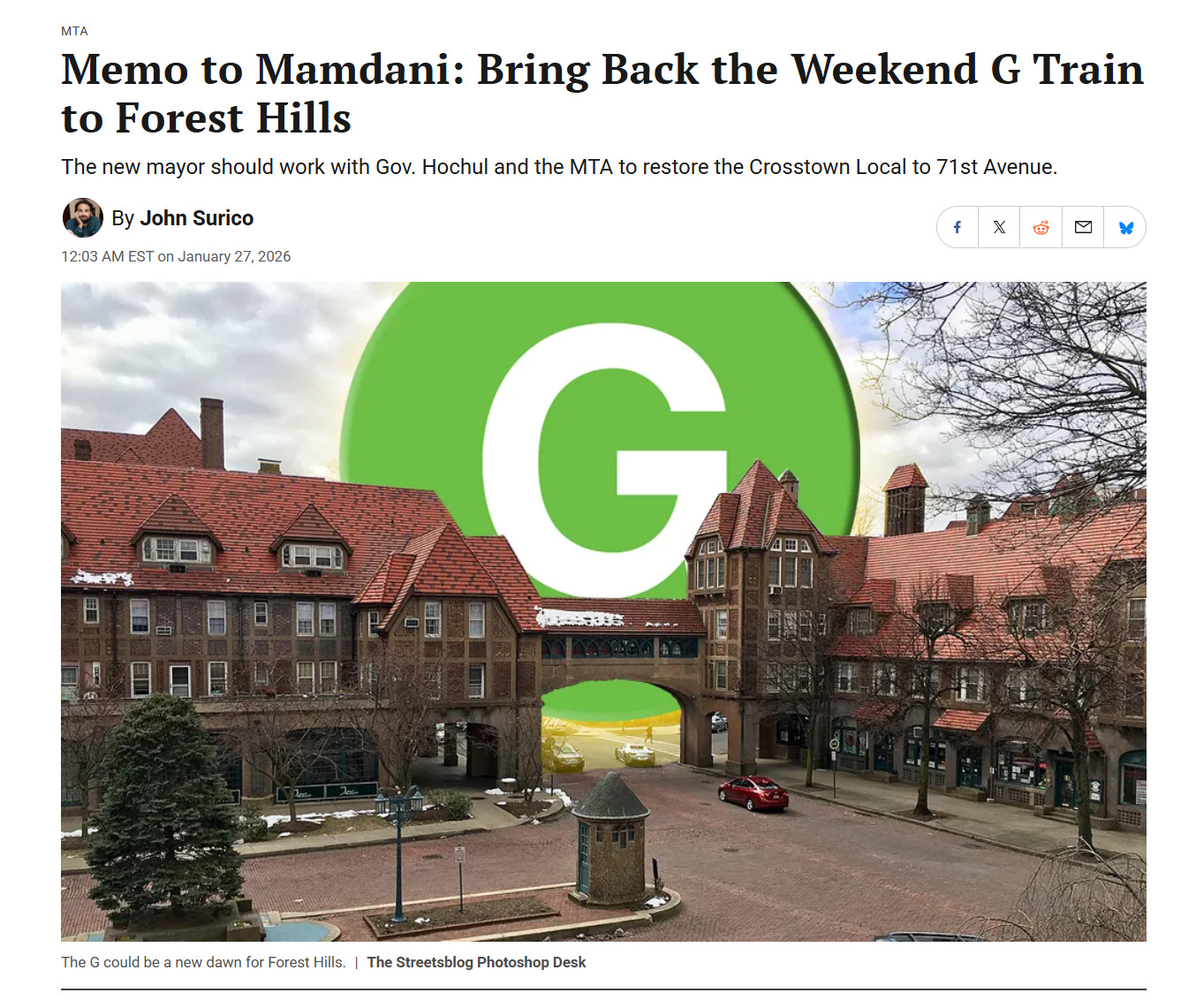
John Surico, no relation, wrote this short, easy-to-grasp memo for Streetsblog. We can reëxtend the G train to Forest Hills from its current terminus, Court Sq in Long Island City, on weekends only (so as to not compete for track with the M), sorta…right now. We do not have to build new tunnels, and the community has a history with this connection. The geometry problems are solvable and dovetail nicely with a project I’m involved in, which would support this extension full-time, and that at least two of the authors above are also working on: QueensLink.
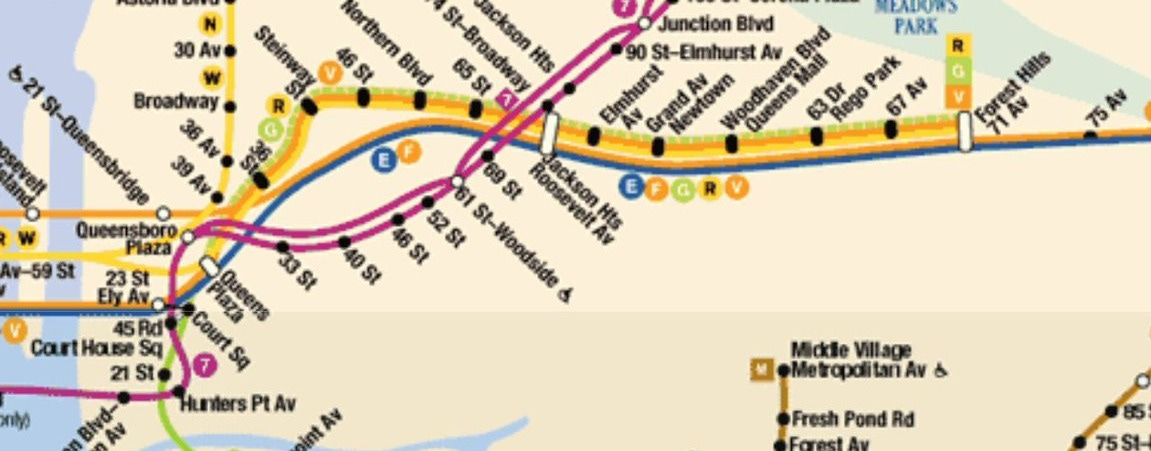
“Build more transit, make it work, and figure the rest out later.” Anyway, go read this (it'll take you 2 minutes) and think about how small transit improvements: speed, frequency, patronage (who's riding with you and how many people?), and coverage (where the service goes and when) *thanks to Jarrett Walker for helping me think about transit like this.6
Friend of the week: Paul Salama from “Transform Government”
Loved this post from Paul Salama. Give him a follow and encourage more stream-of-consciousness that makes a lot of sense!

Second Friend of the week: Jon John Wesolowski, aka
“The Happy Urbanist”

If I’m exasperated, and I am, then Jon Jon, a name so nice you always say it twice, is happy. I love his philosophical musings and especially love his video content @thehappyurbanist. Give a follow to both and think like me—or like you, as if you were me, but you.
Step one: change that awful name.
They’d never be free: we (New Yorkers) would still pay via increased taxes. Sure, billionaires and millionaires would contribute, but we’re all still paying for buses. But without efficiencies gained, how much are we really reaping? It’s nice to remove the friction at the point of purchase, but a fair can also help with demand control to make sure our resources are deployed effectively, not just efficiently. I’d start with expanding the fair fares program and clearing the bus lanes of traffic. I’d also invest in modern dispatching software, transit signal prioritization everywhere, increased safety, security, and comfort at bus stops, and the list goes on. But the point of this paper is to say, “Yes, and…” rather than, “No, but…”
Here’s the thing. You could go to school for two years just to understand the extent of capacity and geometry constraints. I did, in fact, do this.
Because money is fake. No, though, it pulls no punches about how expensive it will be to build under the current cost structures. Thankfully, it covers only capital spending, assuming critically high-end cost ratios, and does not attempt to estimate operations and maintenance. I’m sure an enterprising hater could come up with numbers that make this operationally infeasible, but equally exciting to deconstruct.
Assuming a low-balled, loosely-calculated construction cost of $1 trillion if we were to build the current system, brand new, from scratch, today. I suspect this number creeps toward $2 trillion if we’re real about graft, grift, overhead, and underhead.
Copied this last bit from a LinkedIn post I made about this excellent op-ed a few days ago.