


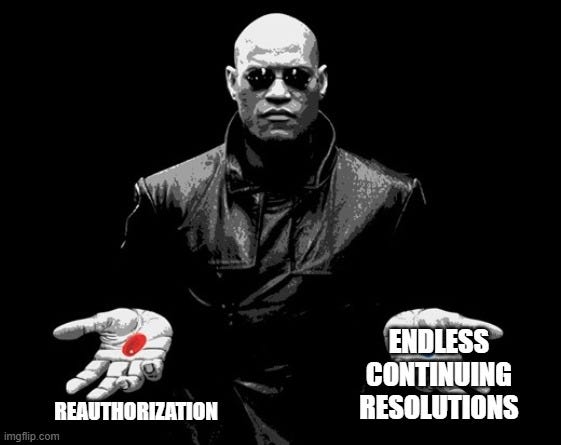
We’re entering The Matrix (as promised)
It’s taken me a year to wrap my head around this next post mostly because reading through thousands of pages of bill text is exhausting in theory and in practice and well, I was waiting for more information on the direction of reauthorization. The good news is that the Federal government still exists. The okay news is that many different Congressional offices have begun the important process of information herding and data gathering and stakeholder engagement.1 The bad news is that there’s likely not going to be enough of a consensus (or government) to pass the IIJA’s successor by the end of September 2026, when the funding authoriziation expires.
What’s right now?
In short, three things could happen:
The funding authorization simply expires and Federal investment in infrastructure would halt. Not ideal as Federal tentacles extend, vigorously, into many corners of the economy.2 This is the nuclear option.
Likelihood: .000001% + the slopulism coefficient.3
We get a new Bill, called something stupid like the Transportation Reauthorization Ultimate Massive Pavement Act. It will keep many programs that don’t work and cut the ones that do. Pork is back so there will be several hundred pages of earmarks for Rs and a few for Ds that lean right. Because this bill will have multi-year authorization and is generally an omnibus effort, it will bloat like crazy and be filled with hydrogen sulfide, seeking to be odorless but deadly. It will pass at $1.5 trillion in new spending that solves no problems and actually makes all of the existing ones worse. But GDP go brrrrr.
Likelihood: 4.7% + log(the slopulism coefficient)
We get a series of 90 to 180-day continuing resolutions (“CRs”) for the remainder of this presidential term that will authorize funding of the IIJA at some percentage of its current levels indefinitely. This is not unheard of—even in normaler times the Federal government will use this option when they can’t come up with a solution to a required problem, when the solutions matrix is so far apart or when the existing spare tire has more life on it and the required parties haven’t finished their problem-solving.
A CR might contain an anomaly that reduces funding or alters policy or attention, but it does not allow for new funding to be authorized or new programs that require funding to start.
Likelihood: 100%. We’re 100% getting a CR this year, especially because this is an election year, and there doesn’t seem to be any urgency to get the TRUMP Act done. We may get multiple CRs
What was there?
I’ve spent too long reading each of the bills not to share this with you. But first:
We’re still in Section 2: Understand some context and history to get a big-picture idea of what’s going on. I have a relatively large spreadsheet that’s gone through a ton of edits and framing to make sure I’ve understood the temperature and tenor of each bill. Big shout-out to Katie Economou of AMPO and Corrigan Salerno of T4America for reading through the crazed notes of someone who’s skimmed nearly 5000 pages of prime government text and providing guidance and feedback.
I have a spreadsheet, and I’m not really sure how to present this so it makes any sense at all, so I’m just going to try this out.
Captain Policy: Or, The Five Lenses of Analysis
With Our Ideas Combined…
It’s always helpful to try to understand the lenses through which advocates and authors might view the development of new policy. For mine, I sought five lenses:
Power, Mode, Complexity, Flexibility, and Geography. They’re all fairly distinct, but I’m going to use these terms in the context of how I would use them.
Power: How does power influence how, where, and what projects are favored? How has this changed over time?
Mode: What’s the focus of this bill? How can we tell what the focus is? How should we talk about this? Is it still highways?
Complexity: How complex does this bill expect our system to be? Are we set up to handle the dispersion of money?
Flexibility: How can money be used? Does the language allocate spending to specific programs or functions? How much is formula vs discretionary?
Geography: Where’s the focus of the investment? More spread out? Need or merit?
Let’s go bill by bill — but starting next week with pre-STURAA (“Surface Transportation and Uniform Relocation Assistance Act of 1987”). Subscribe to get it right to your inbox.
There’s a reason these bills take so long to write. It’s not because it takes so long to type the words on a word processor. Engagement is really hard because most transportation problems are inherently local, up to and including mass transit, street safety, and complete streets. Notably absent? Highways, especially interstate highways. Those are big, relatively unthorny projects. They get funded without question. Notably absent? Interstate rail. We’ve ceded most of it, and there seems to be no real interest in buying it back. Chew on it.
In fact, government spending is one of the five buckets in the typical GDP calculation. And since I know you’re in my footnotes to learn here is that formula: GDP = C (consumption) + I (investments) + G (government spending) + NX (net exports). The “G” is what I’m talking about here. It’s a huge, huge mark of a growth mindset.
It could be any percent, based on how this executive feels like fleecing the American public.