


We are very lucky to live during the denouement of the Internet, where two truths still exist1:
We can still learn new things. Global experience still translates into applicable reform.
A good portion of the uninformed Internet will knot itself into stitches searching for reasons why that first part can’t be true.
For every record, I don’t particularly care how correct the first point is or how ubiquitous the second point is. We’re all in the throes of the Dead Internet Theory, so that really, we can’t be terribly certain that the folks in Camp 1 and the users in Camp 2 aren’t all bots crabappling each other.
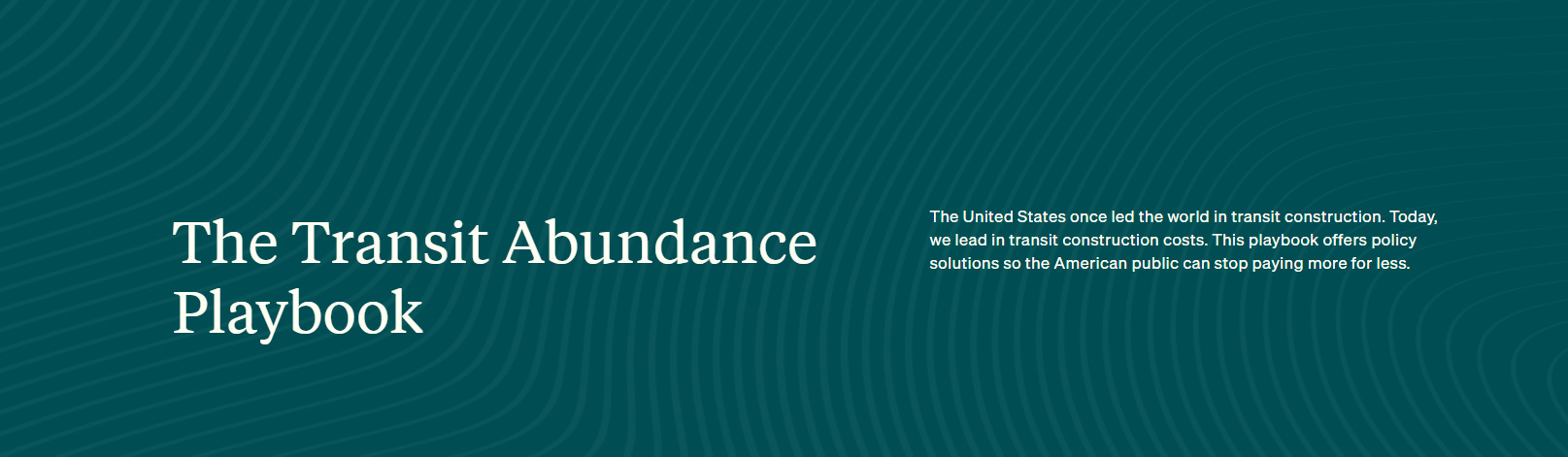
Wriggled in the cracks is a curious compendium, “The Transit Abundance Playbook,” aptly named for its active instructions to fix the broken infrastructure paradigm in America. This book correctly narrows the frame to focus on transit and excludes highways and roads outside support for rubberwheels2, and air and sea. The answer is, in fact, not always more money.3 It is instead filling the gaps between things experts know → things experts think they know → things “experts” think they “know” → and how we source Good projects and pay for them.4
The Playbook is an effective reference tool and a lightning rod to attempt to address the infrastructure game of telephone our professionals play.
SHARING REALLY HELPS ME. IF you liked this, please repost to your networks or email it to a friend.
The Eye-Rolling Transit Knowledge Gap
Let’s define more clearly the gaps to prove the point.
Between what the experts know and what they think they know.
This gap is the narrowest and easiest to fill, and the Playbook effectively addresses it in a few ways: Philip Plotch’s “Share the Truth About Transit Project Failures” and “Transit Projects Need A Single Decision-Maker” (written without attribution) describe the need to build flexible State capacity and to then authorize that capacity to act autonomously. This, it would seem, could be a recipe for success. It continues to be essential for USDOT to act as arbiter among the State DOTs, MPOs, and transit agencies/authorities for data collection and administration of an information clearinghouse. This compendium should be a forum for learning, be nominally exempt from litigation, and focus on incremental effectiveness in project inception through delivery.
Make no mistake: technical assistance programs exist, and USDOT has organized institutes of excellence for project development, contracting, and execution. And yet our assets crumble. We need these tools to foment more.
Between what the experts think they know and what “experts” think they “know.”
There’s a breadth of knowledge question that the Playbook tangentially addresses. Essentially, there’s a whirlwind of mis- or half-information that many “experts” have convinced themselves is true and correct even when the opposite might be true. This, of course, is a communications problem first and a media literacy problem also first. We need reliable communicators with relevant expertise conversing with a public that has an interest in and an ability to learn.
Transparency is a broad theme for the Playbook. Alon Levy’s “We Should Know How Much Transit Components Cost” is a good place as any to start. It does exactly what it says on the tin. To deliver these components better: “Focus Capital Investment Grants on Improved Delivery” from the not-at-all incompetent Stephanie Pollack. The potent combo of media literacy and two-way glass will help close the gap between people who think they know what they’re talking about and those who certainly don’t but insist on writing about infrastructure anyway.
Between what “experts” think they “know” and how we source Good projects and pay for them.
Here’s where the Playbook dramatically works: getting to Good projects; projects that meaningfully address problems as identified by the whole cadre of stakeholders who should be involved. Good projects are obviously better than Bad projects, but no projects are also better than Bad projects. The thing is: the United States seemingly only knows how to build Bad projects and doesn’t, yet, want to build Good projects.
That last gap is filled by the Institute for Progress’ Transit Abundance Playbook. I really recommend reading all the essays as a modern primer for the future of mass movements.
Ranking the Essays Based on How Much I Learned
The criticism has manifested and is unhelpful. Regardless of whether you think the essays are good or helpful or counterproductive or irrelevant, there’s something to learn from each essay. I also realize there’s an irony here of me promoting information that may not be totally correct or helpful—but that’s only super relevant if we’re treating the Playbook as gospel, instead of what it really is—level-setting.5
Even when the authors posited something I know to be half-baked, I tried to learn from their intent, which is what I recommend here. The fifteen essays are useful in the following ways:
“I don’t know much about transit planning, but I’m interested”
Great, go forth with gusto, but remain skeptical. For every opinion, another author could write its counterfactual to varying levels of success. When an author claims x, someone else could just as easily claim y, using orthogonal levels of success relevant to their argument. The Playbook isn’t coded partisan, but the existence of transit itself presents as left-coded…but is it?6
“I am an Urbanist”
Ok, buddy.
“I work in the field”
This is an essential read no matter your experience level. Curiosity is a key component to growth in our field—which is as broad as it is deep. Read to challenge your priors and with the reflexive response “if I’m so correct, why are my ideas not already implemented?”7
“Ezra Klein sent me here because I’m an abundancehead”
Ok, my guy.
I’m skeptical as all get out about abundance as a “movement,” but it is a model to get you, who somehow found your way here, interested in reform as praxis. Welcome!
The List
8 On to the list of essays in order of how much I learned from them. Many of these essays fall into one of three categories:
We can’t adequately price risk, so the premiums we pay to build anything at all skyrocket. We shouldn’t do that.
We can’t adequately or at all communicate project successes and failures so we can’t scale trust or compound learnings.
AI? In this economy?
Go read the essays! Some notes:
I thought Alex and Rohan’s article said much more than just “bus components”—it’s an allegory for the American infrastructure experience. Not only did I learn the most, but also it has the most application outside “buses.”
I’m so curious who the anonymous writer is, but I can’t guess.
Brian Potter’s essay about fire safety tunnels (among others) is tremendous and a great preface to the issues that make a huge impact but don’t make planning textbooks.
I think Jamey Tesler has an inflated opinion of the Goodness of government officials to not deliberately misuse this power to skirt these very regulations.
We’re all necessarily scared to share failures because of our litigious environment that spooks everyone from saying truth at all, let alone out loud. Phil Plotch’s essay helps to plot a course forward, and I was grateful for this insight.
Understanding how capital works, what a capital stack is, who provides the capital, what the fiscal and legal requirements associated with each type of funding are, where it comes from, and how it can be used is…exhausting. Jackson’s essay is endemic of this exhaustion, but unfortunately I don’t know how to make it less exhausting. I have a degree and 15 years’ experience in this—both of this—and it still exhausts me.
I’d love to see what Hayden and Paul’s essays look like together: Fast-track popular projects and give these projects dedicated staff. See how fast we don’t build both State capacity and goodwill.9
Every conversation around AI bores me for the most part, including the conversations around Autonomous Vehicles. They’re coming: capital requires return on its investment, but they’re going to come more slowly than boosters predict, cause more problems than they solve in the short term, and distract us from efficient city building as we look to retrofit rent-seeking instead of building new markets for transit and land use.
What are my thoughts on future essays? We need to talk about good intentions, bad execution with all the overregulation and the lack of decision-making, especially around ADA compliance. We need to talk about the role of the private sector outside of consultants. We need to talk about communications and using the tools of organized labor and riders to push our leaders into decisions that help them fulfill their mandate and give them the cover to make hard choices.10
Bonus: A Brief Conversation with Will Poff-Webster
I had the chance to speak to one of the playbook’s editors—Will Poff-Webster—and here are the five takeaways that have become the commonplace
Defensive proceduralism is the throughline, not any single regulation. Transit agencies get measured on whether they followed every rule, not on whether they actually delivered useful transit. That incentive shapes everything downstream — agencies build in contingencies, bulletproof paperwork against lawsuits, and avoid negative press, all of which slows projects further. The goal shifts from maximizing success to minimizing blame, which produces “a whole lot of nothing.”
»See Eric and Stephanie’s essays.
NEPA is procedural, not substantive — and that’s the whole problem. A project can be shown to be terrible for the environment and still pass NEPA review as long as every step was exhaustively documented. The conversation also corrects a common misconception in real time: the fall of Chevron deference didn’t make NEPA unenforceable; it just removed judicial deference to agency expertise, which arguably makes outcomes less predictable rather than more streamlined.
»No real corollary here, but I always love talking to a lawyer who is interested in infrastructure try to explain Federal procedure to me like I’m 5.11
Bus costs are inflated by Federal reimbursement structure, not complexity. Because the federal government covers 80–85% of bus purchase costs, agencies paying only 15–20% out of pocket have little incentive to resist vendor upselling on unnecessary customization — like unique interior floors — driving US bus costs 30–100% above international norms.
»See Rohan and Alex’s essay about bus customization. Also the other essays about purchase and procurement reform.
Italy’s “Conference of Services” model offers a real alternative to endless litigation. Rather than let every stakeholder (utilities, localities, landowners) sue individually over years, Italy convenes everyone up front under a single accountable decision-maker — often proposed as a governor equivalent in the US — who hears all requests, makes binding trade-offs, and sets a hard end date after which the project can’t be re-litigated. Marc Dunkelman’s book Why Nothing Works is cited as making a parallel argument: America’s dysfunction often comes from an unwillingness to just decide.
»Read Alon’s essay for more on this.
Well-intentioned accessibility rules can end up making buildings less accessible overall. ADA and elevator-code requirements — like mandating that two full-size wheelchairs be able to pass each other on a platform, or that a wheelchair be able to turn around inside an elevator car — sound like pure wins, but they force much larger stations and elevators than other countries build. The unintended result: many small buildings and constrained sites (like on the Long Island Rail Road, where there’s no right-of-way to widen without condemning property) just don’t get elevators built at all, which is worse for accessibility than a more context-sensitive design would be. There’s reportedly a group of wheelchair users themselves now pushing for elevator-code reform for exactly this reason — a case where rigid compliance defeats the goal it was meant to serve.
The platform passing-space detail in this last point is relayed secondhand in the transcript (from a station engineer a source spoke with) and simplifies the actual rule — ADA requires 60”×60” passing spaces at intervals along a route, not continuous two-wheelchair-wide clearance throughout. The elevator turning-space requirement, by contrast, is accurate as stated.
»This came from a part of our conversation talking about future essays. ADA came up as a well-intentioned and helpful organizing tool, but in practice has some unintended consequences. See also: Wednesday’s Headlines: Delay Tactics Edition from Streetsblog for more on this.
Do you all want to see the full conversation with Will? Comment below!
At least for transportation planning and policy professionals.
Buses. I’m talking about buses but using a funny word. Why? Because it’s more interesting to me.
Which, if you’ve been here for any amount of time, you’ll know is the thesis of this whole blog: “We don’t know how to spend $1 trillion.” It’s actually a moral hazard to continue feeding the broken beast. QED.
A quick aside, which we all know you’re here for: I desperately despise the phrase “shovel-ready” when qualifying an infrastructure project. Instead, we should promote “shovel-worthy” projects: terraforming that fulfills some thesis other than this was the project the funding and parameters allowed for. To its great credit, many of the Playbook’s entries address this point head-on.
Part of the media literacy I’m pontificating about here is learning when to accept a finding as “true” and when to continue poking at it with every rhetorical possible. The answer is, of course, never and always.
It seems this is true when observing transit’s boosters from the expert to “expert” gap, but even when we’ve had left-ish governments, we still fund mostly highways. It’s almost like the Dems and the GOP are simply…two factions of the capital class.
Except this blog, because I am necessarily right.
I really need to learn how to clear my throat faster, but that’s part of the exasperation.
Well, maybe not from the consultants.
If you notice, I covered left, center, and right politics in three full sentences.
I am not.
Sam - I really enjoy your insights but the white on blue background is rough! Would you consider a more accessible combo?