


Reference (will be at the top of every post):
Power: How does power influence how, where, and what projects are favored? How has this changed over time?
Mode: What’s the focus of this bill? How can we tell what the focus is? How should we talk about this? Is it still highways?
Complexity: How complex does this bill expect our system to be? Are we set up to handle the dispersion of money?
Flexibility: How can money be used? Does the language allocate spending to specific programs or functions? How much is formula vs discretionary?
Geography: Where’s the focus of the investment? More spread out? Need or merit?
MAP-21:
“Moving Ahead for Progress in the 21st Century Act”
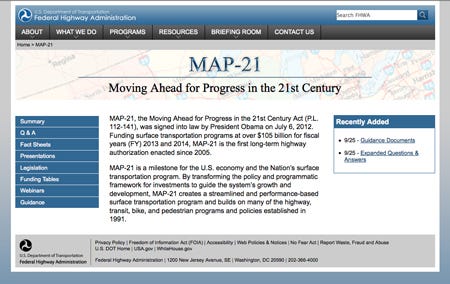
Twelve years in and we’ve made …progress that we should …move ahead …for. Congress aimed MAP-21’s text at program reformation—hopefully allowing for a better spend. What could we achieve if the methods by which we disbursed authorized dollars were more closely related to the expected objectives without these intentions being too hard to implement, track, and measure?
MAP-21 did not answer this question, even with its best intentions. Though it did seek to consolidate discretionary (competitive) programs from SAFETEA-LU and TEA-21, it still encouraged lots of highway spending and incomplete performance measures that allowed for some wacky results from our state DOTs. For example, tied to some dollars here was the promise to make our roads safer through design and construction intervention—but the performance measures didn’t hold recipients to some objective standard. If [insert state here] sought to reduce fatalities, all it had to do was to set a higher target than the number of crashes last cycle and then do…nothing.
So what are we spending our tax dollars on, really?
Power: State >> Regional >> Federal >> Local. MPOs get some more power here with “transportation alternatives” programs split between the regions and the states, though one can imagine what a state DOT (highways) would do with its share, and one might even imagine the state gumming up these funds for “flexibility” reasons. Really, though, the ownership/responsibility matrix continues to be goofy and wholly American: should a state own a “local” road only to forget about it when the time comes to reconfigure it? Should we signal that we want to install bike/ped infrastructure on state roads—most of which are limited access or highways that probably should separate modes more than the allocated funds would allow? The logic doesn’t follow once you realize the whole funding game is akin to “telephone.”
Mode: The omnibus bill reauthorizes spending for the modes, separately for the most part. Safety remains a big issue (but not really). It provides separate funding for the first time for “transportation alternatives,” which include non-highway related, non-auto-related spending dollars specially set aside and applied both formulaically and competitively.
Complexity: This bill was the first time the Fed made a concerted effort to shrink/consolidate the number of discretionary programs to administer them better. Some programs (New Freedoms?1) simply fell by the wayside.
MAP-21 continued USDOT’s approach to performance-based planning, asking recipients of federal funds to more thoughtfully organize project development, selection, and construction. Projects have become significantly more challenging; much of the easy ones are accounted for, and the land is developed in the densest of places. There are competing priorities and limited space. How best to organize and tie funding to its highest and best use? Who is the right actor for this?
Flexibility: The TA program compelled states to reckon with non-highway spending in earnest, in theory. “Flexibility,” as we entered the 2010s, was heavily tied to very specific definitions of what was and wasn’t allowed, rather than by mode. Lots of discretion is afforded to the Secretary to decide what does and does not meet certain thresholds. Lots of DOTs understand flexibility to mean they can flexibly ignore DOT directives by flexibly claiming the funds should flex to highway spending.
Geography: No earmarks here, so the geography of MAP-21’s investment is devolved to the states and the consolidated discretionary programs. There’s horse trading inside the distribution of competitive funds. My take is that this actually made corruption worse because it wasn’t as nakedly obvious to follow.
Here’s a great guide from T4America that says more:
Catch up on older posts in this series below:

For elderly Americans. Happy trails…not.