


Relive Session 1 Below:

BRUUUUUUUUUUUUUUUUUUCE: Session 2 below
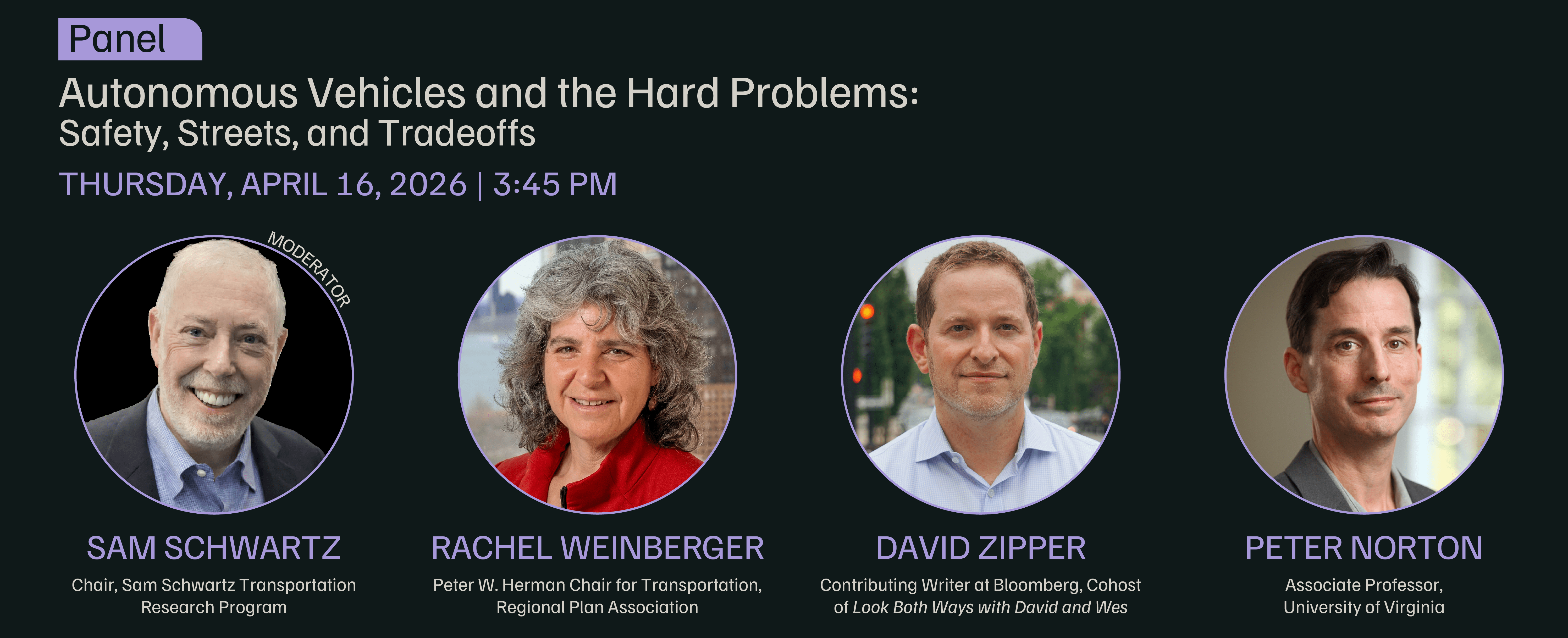
Peter Norton, Associate Professor at the University of Virginia
Rachel Weinberger, Peter W. Herman Chair for Transportation at the Regional Plan Association
David Zipper, Contributing Writer at Bloomberg and cohost of Look Both Ways with David and Wes
Moderated by Sam Schwartz, Chair of the Transportation Research Program at Roosevelt House
What I Expected:
Pushback. The title of this session centers on the “hard” problems. Also, knowing the panelists, I was expecting nothing less than a rebuke of the previous session; a “hold on, the sales pitch shouldn’t hoodwink you.” These panelists are well-known deep thinkers, and having them on the same dais was…intentionally hilarious. Having “Gridlock” Sam Schwartz himself moderate added gravitas, levity, and direction that helped guide this discussion to productive and not…a roundabout AV bashing on the AV panel at the AV conference.
What I Learned:
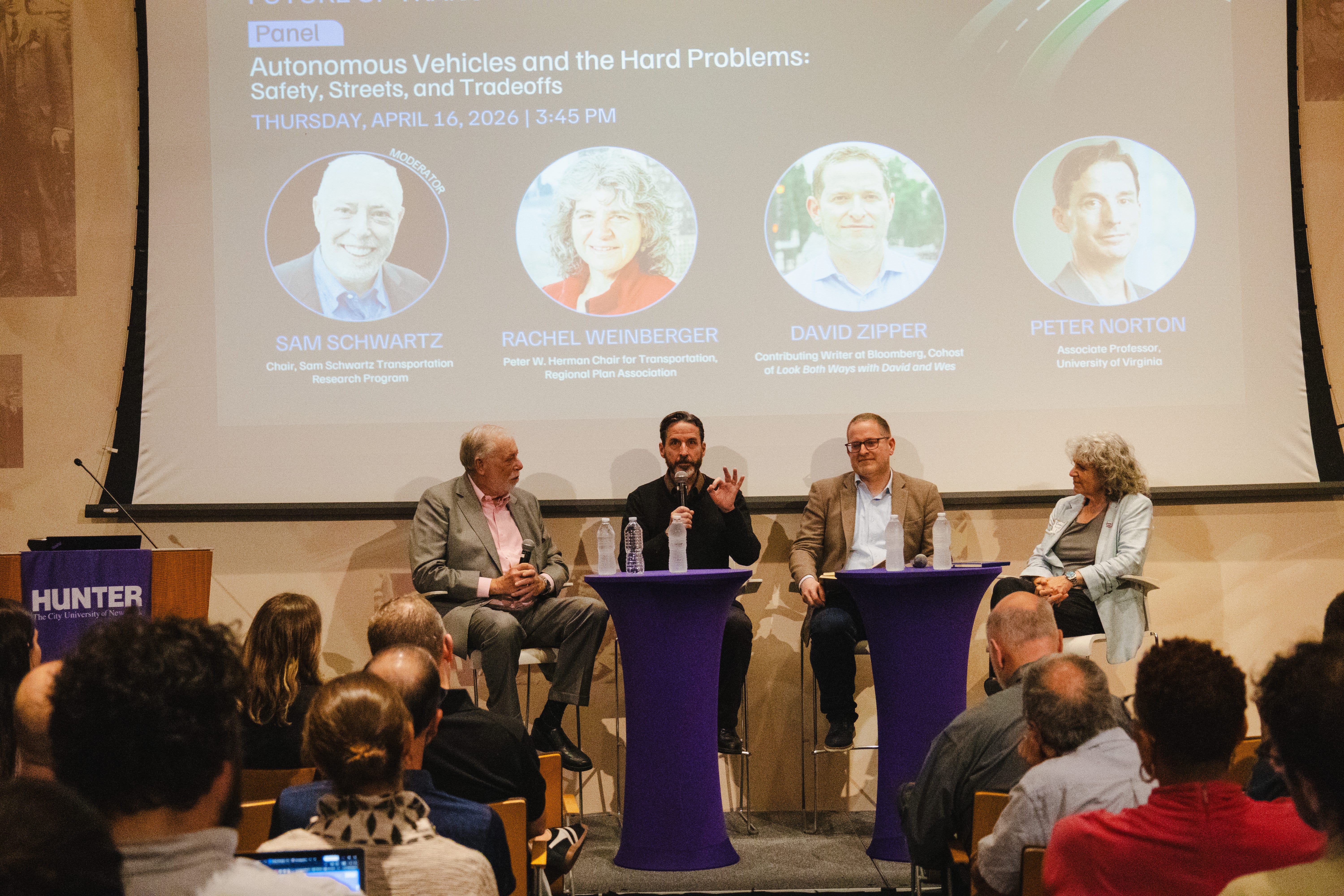
We got a mini-soliloquy from each of the panelists as they introduced themselves, which set the tone.
Peter Norton: “Who decided these vehicles are autonomous? Some human programs are needed. Are we engineering autonomy? Can we still navigate independent of signals and by celestial navigation instead?”
Rachel Weinberger: “AVs are a solution to a problem that’s not yet defined, but their development is driven by the logic of capitalism. What is the role of AVs as defined by the geometry of public space?”
David Zipper: Referring to the previous panel, whose members were not in the room: “If the private companies want to engage with the tough questions, they should stick around. Why are these AVs coming to cities with the lowest crash rates in 115 years and not to rural areas where the use case makes much more sense?”
Sam starts the questions: “Is NYC really that different than other places? Did the governor make the right decision” to end the AV trial period?
Rachel: Apparently, yes. We have the moment to think about what we want. “How do we make these vehicles work?” Wrong question. “How can we use AVs to do the thing that we want?”
David: Hochul’s bill exempted NYC, but the path forward is to improve transit. We don’t need to scale AVs to make NYC a faster and safer space.
Peter: There are important similarities between San Fransicso and New York City. SF’s Board of Supervisors said “no” and got overruled by the State Utilities Commission. The difference is not just the city but the responsiveness of the government to the people. I feel helpless to watch history repeat: In 1971, John Lindsay tried to implement a “Red Zone,” there was backlash (shocker), and it was pulled. In 1922, William McAdoo had to remind motorists that streets do not belong to motorists, “No pleasure cars below 14th St,” he said to unsurprising PANIC from motordom.
Rachel: The “safety” conversation is a red herring. We have the tech to make cars safer, irrespective of whether they’re autonomous or not. Cars won by conquest, and just because we agree with each other doesn’t mean that we’re wrong and the “industry” is right.
David: Oslo and Helsinki reported no crash deaths, and you know what they don’t have? AVs.
Sam’s note: Peter Norton is a world-class historian, and Rachel and David are world-class researchers and practitioners. This panel is dripping with sarcasm and sincerity. Every fact is interesting, and every quip is biting. You hang on every word.
Sam says: “Should we use deaths per VMT or deaths per capita?”
David: Because of exposure per capita is better.
Rachel: Why are we so overreliant on individualized transportation…the sum of ideas doesn’t equal total system safety. Waymo is “fun,” but crushed by sheer volume.
Sam’s note: This is a very interesting angle. What David meant here, I think, is that if we just measure crashes per vehicle mile traveled, we’re only measuring risk on our roadways and not the full ecosystem, which includes non-AVs, like, you know, pedestrians and cyclists.
Sam says: “What happens in the city in 10 years…or by 2050? While the industry continues to spend millions lobbying.”
Rachel: Do we keep kicking the can on major projects like the BQE, the West Side Highway, and the Williamsburg Bridge? We need a radical revision of street use. Do we promote a half-width car? The vision is to have better ways to move around the city.
Sam: Elon Musk says all the negative articles dissuading AV use are killing people.
David: “You’re killing people by pointing out gaps in our argument!” I wish we were so powerful…Every lobbyist in DC is on retainer with Waymo. Are Waymos safer than drivers? Waymo says…yes! Academics say…we don’t know! There’s lots of money at stake.
Sam’s note: We love kicking the can. There’s a reason we don’t really trust industry regulating itself, because which master are they serving? And what if the academics or regulators or third-party, non-interested reviewers say different?
Sam says: “Should an AV company hire you, Peter, what would your advice be?
Peter: The shortest answer is that we have to remember the distinction between tool and solution, and tech companies deliberately obfuscate this distinction…The “tool” expands autonomy, and the “solution” replaces the user. What happens when we have systems that do all the things for you? You’re no longer a responsible party. Rachel Carson was right: we misperceived insecticide use and the problems they cause. There’s a real correlation here to AVs: they’re not salvation and not deliverance.
David: This is capitalism.
Rachel: These companies are doing what they’re designed to do in the system we designed.
David: I would give advice to NHTSA, Congress, Governor Hochul, and the FTC that we’ve completely abdicated responsibility on behalf of industry. The real failure is with the regulators.
Peter: If your city does not have the capacity to rise to this occasion, then you’re going to end up with rules written for you by the companies you’re supposed to be regulating. A century ago, street capacity was a public resource to be allocated in the public interest; if you got a monopoly on the street (via trams/Subway), you gave the city what it wanted in return. How do we connect to rural communities? Claire Campbell says: initiatives fail because of a lack of narrative…what’s the narrative that engages industry to imagine road space as a public utility?
David: The narrative is money. Taxpayers’ dollars seeded DARPA, which did the initial research into AVs. We have rural AV centers that are funded in Wisconsin and Oklahoma to figure out the use cases…is there not enough traffic, is the cell service too spotty, do we then enable the private sector to step in?
Sam’s note: I wholeheartedly agree about the narrative that controls the initiative order, and that we’ve let the private sector control the narrative and ultimately the initiative. It’s cool that the research still happens at universities and that there’s a focus on making a stronger narrative use case for rural AVs, where the real promise is.
Odds’n’Ends:
This panel lived up to my expectations, if for nothing else than Professor Norton’s urban history tales, David’s incredulity that we’re even having this discussion without the boosters there to hear criticisms, and Rachel’s hard-earned skepticism. To have “Gridlock” Sam Schwartz moderating? What a treat. Look into Clarie Campbell if you care about storytelling, and really ignore El*n Mu*k until he does something of value beyond yapping and tricking incels into paying him with attention.
PS: The panel’s introducer called Sam the Bruce Springsteen of transportation, and I can’t remember why. But it’s in the video below. Happy background watching.
Thanks for this! also lol, talk about silos, I teach at Hunter UPP and didn’t even know about this.