


I’ve been meaning to give John, Bern, and Andrew a fair shake at the exasperated alter through conversation and a reading of not only their 1st edition, but also a rapidly decaying policy prescription in the 2nd edition of The End of Driving.
First, a spoiler and a note about this review. No, this book is not calling for the end of cars (or life after them), and it’s not calling for a revolution to pull all planning and infrastructure development toward the vehicle, autonomous or not. It’s not an AV apologists’ book; rather, its authors write matter-of-fact and it’s this approach that lends credence to their words. Their words, written with decades of experience, seek to put a pin in the current moment, which, just now, is behind us. This technology is evolving rapidly, and these authors—Bern Grush, John Niles, and Andrew Miller have caught a moment and given us tools to evaluate the next iteration.
Second, John and I speak fairly regularly about goings on across the country in AV policy and beyond. Our friendship will not affect my objectivity in this review. That serves no one.
The Premise:
This book could be a ~casual~ beach read.
It’s written in chapters — 15 of them — with compelling titles:
Hype, dissolusionment, and reset
A challenging transition: two competing markets
Backcasting: Steps to achieve desired futures
Nudging ride-buying with microsubsidies
It sounds like I’m joking and poking fun, but these are honest-to-goodness hot-button issues that we as an industry are working through. If nothing else, it puts all the issues these authors sought to explore all in one place and you can have access to them,. decidedly argued and dressed up with research and conclusion, in this one book.
Reading this cover to cover is certainly a choice and with so many other things you could read, taking this one slowly—or attending a session with the authors—might be your best course of action.
You might also choose to read this as an academic text or a reference guide.
My argument here is this: deeply understanding the questions associated with vehicle automation will allow you to develop authority as a serious scholar on the topic. AVs aren’t going away, but they’re also not going “replace” transit as a mode. There will be a centerground that this book will allow you to figure out for yourself because this topic and its component “solutions” move at multiple speeds and many directions.1
Questions you might want to ask:
What does automation actually mean?
How should we reorganize our public space to accommodate these vehicles?
Will AVs replace or enhance solo driving or public transit? To what extent?
What are the macro, meso, and micreoeconomic questions we still have to develop differential solutions for?
Who should lead the policy forums? Locals, states? USDOT? The private sector
And so on. This book has been, since its first edition in 2018, the best tome for helping practitioners and policymakers understand these very complicated issues.
The Prose:
John, Bern, and Andrew are gifted scholars with a long-tail view of this technology and its accompanying economics and policy. This book, though, is not an easy read by any means. It expects basic-to-intermediate-to-advanced literacy in transportation planning and economics and policy analysis and without graduate-level coursework, much of the layered nuance will be relatively inaccessible.
However, that doesn’t mean this book is out of reach. With its sources and a hefty inquitision The End of Driving might be the way in for you or a colleauge or friend.
For an example of this duality:
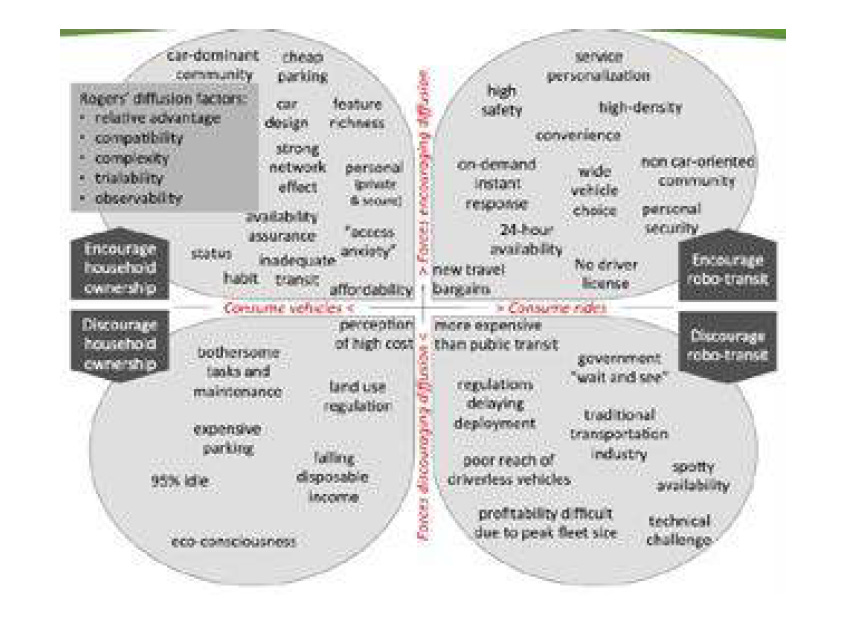
Dual diffusion is not new. There have always been two markets for mobility: the ownership of a private conveyance vs the hire of a provisioned ride. In the 20th century, this tension was expressed as private car versus transit and taxi. The regulation of for-hire vehicles stretches back at least to the 1650s in the form of hackney carriages. Surely travelers hired rides long before that. The portion of any population that owns a private conveyance versus hired rides has always varied over time, place, and wealth. The fact of variation likely will never change, and the assumption that a technology enabler alone is enough to eradicate this multifaceted interplay is naive. Will person-travel in 2050 be predominately satisfied by optimized fleets of shared vehicles? This outcome is possible but has neither a guaranteed nor even described path to realization. This book argues that such an outcome is appealing and, for planners, superior to the alternatives. This is the basis of the proposed approaches to flexible, automated public transit in Chapter 11: Microtransit Rising and Chapter 12: Nudging Ride-buying with Microsubsidies.
—The End of Driving, p.66
What do we get here. The language is stiff and correct, and aware of both. What I won’t argue is that it’s boring or not a welcome addition to the canon. This, however, is the policy equivalent of a word cloud and would have been better either bigger, simpler, or left on the editing floor. This is one of a bunch of graphics that could have used some more thought before publish.
My criticisms are light and straightforward. I’m proud of this book and while I don’t agree with everything the authors argue, it continues to be important to argue the broad and fine points with people with whom I agree and disagree. The book is well-written and well-argued and the base knowledge given is superb.
The biggest problem I have with this book is its price and limited access. At its cheapest, the book is $100, which puts it out of reach for a non-professional, non-academic, or non-very-bad-gifter. This price is not the authors’ fault, but it does prove to be a significant gatekeep for how important this knowledge is to not be locked behind a literal paywall. That said, I’ll put a link below to do my friends a favor.
{Placeholder for 4/1 recording}
Private, public, and nonprofit partners in this space, at the local, regional, state and Federal levels are constantly battling for space in the technology and policy worlds. All driven by capital, of course.
Sam, thanks very much for this informative and generally positive review of the work from me and colleagues! I deeply appreciate this judgment of yours: "This book has been, since its first edition in 2018, the best tome for helping practitioners and policymakers understand these very complicated [automated vehicle deployment] issues." The two editions of The End of Driving have been a decade of work focus from me, not even taking my co-authors into account who of course more than double the investment. It's nice to have recognition from an outside professional that there has been a payoff.
One question -- can you please expand on the phrase "a rapidly decaying policy prescription in the 2nd edition of The End of Driving" and in particular the words "rapidly decaying." Perhaps you only need to point out the portion of your review that is explaining this phrase. I didn't see it, even though I could myself come up with possibilities for what you may mean without having explained any in your review. I'll stop here but I'm ready to discuss the "rapidly decaying" stuff in further comments after you chime in. Thx, JSN