


Note! You can find Russell’s takes on his blog, The Transport Leader. I’ll link to the sections below. Note2: Russell is Australian and spellings reflect our cultural differences!
Key Takeaways
In this blog, Russell King and I discuss the pros and cons of free fares and car pooling in response to the oil crisis.
In favour of free fares:
Removing fare collection speeds up boarding times, improves schedule reliability, and creates a positive ridership spiral that benefits the whole network.
Free or heavily subsidised fares send a powerful signal that travel is a right rather than a privilege, shifting the cultural default away from car dependency.
In some cases, the administrative cost of processing fares can actually exceed the fare revenue itself, making subsidisation not just socially beneficial but economically rational.
Against free fares:
Free fares are a blunt instrument. The financial incentive to switch from driving already exists when fuel prices are high.
Fare subsidies are rarely funded by new progressive taxation; in practice, they tend to come at the expense of maintenance and capital investment.
Once introduced, free fare policies are politically very difficult to reverse, even when their shortcomings become apparent.
Overcrowding is one of the most powerful deterrents to long-term public transport use, and free fares can accelerate it.
New public transport patronage driven by free fares often comes from people who were previously walking or cycling, not from former drivers.
In favour of car pooling:
High fuel prices have created a rare window of opportunity where people are genuinely more open to changing their travel habits.
Pulling multiple policy levers simultaneously: HOV lanes, matching apps, tax incentives, and parking charges, is what delivers successful carpooling.
Unlike free fares, carpooling once established largely sustains itself without ongoing public subsidy, making it a crisis intervention with genuine long-term benefits.
Against car pooling:
Even a shared car trip is still a car trip, and in most cases, the better long-term investment is in robust public transit that removes the need for the journey entirely.
The logistics of meaningfully matching carpoolers are complex enough that the administrative burden often outweighs the benefit, except in a handful of naturally occurring cases like workplace commutes.
Over-incentivising carpooling risks inducing car trips that would not otherwise have happened, potentially making congestion and fuel consumption worse rather than better.
Introduction
This week, I’m back with Sam Sklar of the Exasperated Infrastructures newsletter for the second instalment of our ongoing series on policy responses to the oil crisis. If you missed last week’s discussion on improving bus services, you can catch up here.
This time, we’re turning our attention to two topics that sit at the heart of the transport policy debate: public transit fares and carpooling, a measure long championed as a magic bullet, yet one that has stubbornly resisted successful implementation almost everywhere it has been tried.
As before, Russell and I will be laying out the arguments on both sides and leaving the verdict up to you.

Part 1 - Fares
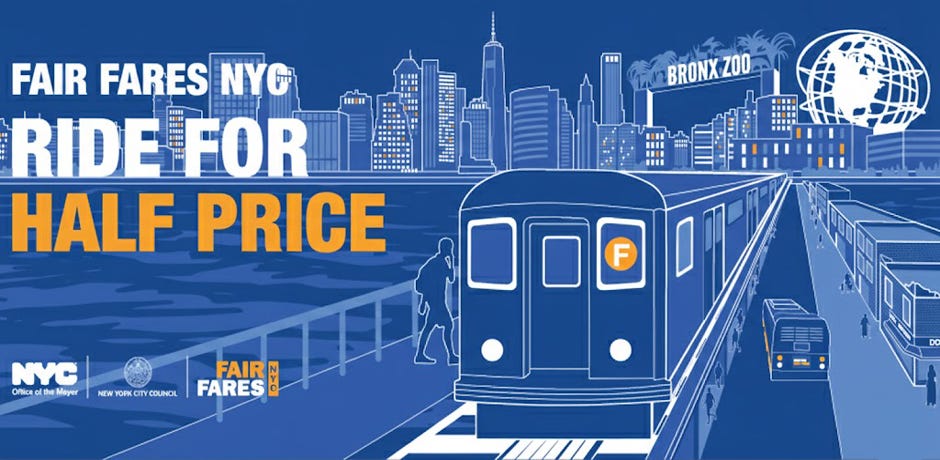
Even before the current oil crisis, the idea of cheap or free public transit fares had been gaining serious traction in policy circles. Nowhere is this more visible than in New York, where Sam is based: the city’s newly elected Mayor campaigned on a promise of free buses for all New Yorkers, although he has since conceded that this won’t be happening in the immediate future.
The crisis, however, has given the debate fresh urgency. Several jurisdictions have already moved from discussion to action, including here in Australia, where both Victoria and Tasmania have announced free fare policies in direct response to the crisis.
The Case for Cheap or Free Fares (Sam)
This is a particularly hot-button issue in New York City at the moment. Our mayor, Zohran Mamdani, ran on an affordability platform that included, among other promises, “Fast and Free Buses.” There are lots of arguments to do this, but I’ll cover three here: economic, political, and operational.
First and the most contentious argument: economics. Someone has to pay for bus operations, and often the user fees cover very little of the actual cost to run the buses or trains; the rest must come from operating subsidies, often funded by taxes or special assessments. If the farebox recovery (what percent of the costs are covered by user fees) is low enough, the question becomes, “Is there a reasonable source of dollars to replace user fees?” with, “Is this the highest and best use of these dollars?” Who wins and who pays? I think the benefits outweigh the costs in many situations, and what a good problem to have, “too many transit riders.” In the face of an oil crisis, great and free transit is a lifesaver where it exists.
Second, political. This is a campaign promise that the mayor can…partially deliver on. The City of New York controls the streets and sidewalks, but the State operates the actual buses and Subways. The Mayor, and to an extent, City Council (in New York—structures are different in every place) can pass laws and issue directives to create, clear, and/or enforce bus lane operations and build benches and shelters to encourage a dignified wait for the next bus. The Subways are a different economics, and a fare-free Subway is always challenging. Here, I’d look to start smaller. Instead of transferring the burden of cost all at once, perhaps the City and State can think of partial fare-free offerings. Perhaps the busiest trunk lines are free, or the buses are free on weekends. The idea here is twofold: deliver on a campaign promise and parlay this win into bigger and better wins, and to do meaningful policy to create a regime where transit is the default option in many cases for many people.
Free doesn’t always mean better, but this policy has ramifications beyond the economics. It signals that travel is a right, not a privilege, and driving is a choice with multiple other options, should gas be too expensive to make many trips, or driving be too burdensome to have it as the only choice.
Third, there are operational considerations. Fast and free often go together when it comes to bus operations, or at least there’s a strong correlation between the two. If the driver doesn’t also have to monitor fare collection, they are free to focus on excellent service and not crowd control. If the driver doesn’t have to collect fares (faster now that cash is mostly phased out and OMNY is a “tap”), they can keep to a tighter schedule, which increases route reliability, which increases ridership—the positive spiral to counter the negative funding spiral we hear about. If each rider takes 5 seconds to tap in and there are 10 riders…that’s almost a minute saved per stop. On a 50-stop route, these small savings add up. Across a whole network with thousands of buses, imagine how much time this generally saves, and goes back into the pockets of New Yorkers. You’re trading upfront dollars for economic activity.
At this point, your problem is how to communicate these benefits. One is real dollars and cents, and the other is “the economy.” Tell stories all the time, and this is an easy sell.
On the back end, agencies no longer have to process payments and administer relationships with vendors or processors. In some cases, the cost to process a fare will continue to rise even if fares remain static. The unit economics can be very tight, and sometimes—in some cases—the cost to administer each fare actually exceeds the cost of the fare. Everyone loses.
There are a ton of reasons to heavily subsidize or make fares free for transit riders. There are examples where this has been successful and others where it hasn’t quite worked the way boosters expected. In any case, it’s worth piloting and seeing if we can’t provide a better city that runs on mass transit.
The Case Against (Russell)
Part 2 - Car Pooling
Carpooling, the sharing of car journeys between two or more people, is one of those policy ideas that seems almost too sensible to argue with. Fewer cars carrying more people means less congestion, lower fuel consumption, and reduced travel costs for everyone involved. In the context of an oil crisis, the logic is compelling: no new infrastructure required, no large public expenditure, just better use of the cars already on the road.
So what are the pros and cons of promoting car pooling in response to the oil crisis?
The Case for Encouraging Car Pooling (Russell)
The Case Against Car Pooling (Sam)
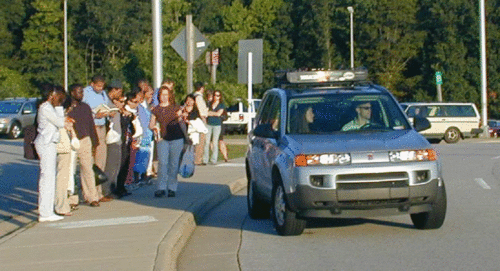
Carpooling is a demand management technique that encourages drivers or would-be drivers to share a ride should they start in *relatively* the same location and end in the *relatively* same location. In theory, two people per car saves gas, time, money, and helps to shrink the burden on our roads via a reduction in traffic. Promoting carpooling as more than a tiny piece in the traffic puzzle is unrealistic and should be considered a fringe case for three reasons. First, all else equal a car trip is still a car trip, even if it’s shared. Better would be to build and operate a robust transit system so that both trips could be transit, bike, or pedestrian. Second, the logistics to match people requires luck and trust, along with an understanding of demand dynamics that certainly overcomplicates what should be a simple idea. Last, and related to mode shift, is a density shift. If travelers know a car trip exists and don’t have access to reliable transit, that’s another car on the road that either could have been left at home or operated with one to many passengers. A car trip is still another car on the road that may not have been there otherwise.
It Diverts Attention from Building Robust Transit
First, even during the first of what will likely be many oil crises in the next decade, we need to be investing in public transit as the preferred option in many cases. In all but the most obvious cases, we should look to invest in “super” car pooling, where perhaps 20-50 people gather in a single vehicle, perhaps with a driver, to head in the same direction. In cases where that’s not possible, we shouldn’t be encouraging vehicle trips of less than 6 or so people instead of driving alone: technology is here to help in the form of autonomous shuttles, driverless buses, and robotaxis. Frankly, “carpooling” is a twentieth-century idea, and promoting it when there are so many other options is selling human ingenuity short.
Logistics, Logistics, Logistics
Second, the dollar and environmental cost and mental burden to facilitate beneficial carpooling often outweighs simply driving alone—especially if AI is involved. The only way to make carpooling work, really, is if there’s a natural and unstructured way to offer it: to and from work if enough people live together and, famously, on slug lines, in places that have high vehicle traffic, lots of demand, and an incentive for fuller vehicles.
For example, for many years, EZPass offered a discount for a car with 3 or more people to cross the George Washington Bridge from New Jersey into New York. Often, a single-occupancy car would approach the bus stop and pick up a few strangers to take advantage of the discount. The driver would get a smaller toll, and the bus passengers would get a free trip over the bridge, compared to a few or so dollars. Lots of risk here, no? It proves the natural market exists, but it’s often such a headache to regulate that it would be worth understanding the incentives and offering a transit alternative.
It Induces Car Trips
Last, there’s simply a volume problem. If we incentivize carpool trips even a little too much, we’re inducing car trips that wouldn’t have otherwise occurred, exacerbating the problem we’re trying to address. What’s the right incentive structure? In a bafflingly complicated world, it’s impossible to get perfectly correct, and we’ve made our problem …worse. It’s counterintuitive, and it doesn’t help travelers survive an oil crisis.
In all but the most obvious cases where transit makes little sense, the technology hasn’t caught up, and we’re sure of administering logistics (who administers?) to make meaningful change, encouraging carpooling on its own is benign with little actual benefit.
Conclusion
Both debates we’ve explored today reveal a recurring tension at the heart of transport policy: the difference between what looks like a solution and what actually works.
Free fares and carpooling share a certain intuitive appeal. They are easy to explain, easy to sell, and easy to reach for when a crisis demands visible action. But as we have each argued, from different directions and on different issues, even the most superficially appealing interventions have unintended consequences.
We’ve tried to lay out the arguments fairly and leave the verdict to you. We’d love to hear where you land, and what we’ve missed.