


First, hello to all new subs from DC this week. It was great to meet all of you and you’ll be able to find me here, on LinkedIn, by email, or by text if we bumped iPhones.1
Second, and as always, feel free to share this post with friends or colleagues who you’d think would like a weekly dose of exasperation and policy, interviews and book reviews, and long-form essays (reauth takes are coming…soon).
Third, sorry this is very late. My computer broke last Saturday and no one was happy.
Dispatches from Washington DC
Each January, the Transportation Research Board (TRB) hosts its annual meeting (AM) in Washington DC’s Washington Convention Center.2 And three years from four I attend the hallways and happy hours portion of the conference—meaning I make my way to DC and spend four to five days taking meetings, coffees, and lunches with colleagues and coworkers, new and old, to build and deepen relationships. I’ll say that in my career, gliding through downtown DC for a few days each January has been the most influential week in my burgeoning career.
5 Dos and Donts from a decade at #TRBAM
I’ve been told to use more lists in my screeds.
DO attend the conference if you’re an academic or an aspiring researcher in the field.
The TRB is a project of the National Science Foundation and is, first and foremost, an academic and research body. There operate dozens of different committees, theoretically, whose function is to manage ideas and research related to the transportation, infrastructure, and inreasingly, intelligent systems field. In between the presentations of research and findings, the committees meet and discuss alll things from structure to focus among other topics related to the committee. If you’re an academic, in school to become one, or are simply the largest nerd, it is worthwhile to attend the conference over its 4 days. If you’re a practitioner, advocate, or lesser nerd, the content of the conference itself may not be your best choice for time spend.
DON’T expect to take in the entire conference at once.
In years’ past, close to 10,000 people have descended upon DC for the conference from all walks of life and relationships to the field. I will say the 2026 conference felt more subdued than usual, even though I didn’t attend the conference. I’ve heard rumblings attendance was down about 40%, somewhat attributable to the ongoing changes in committee structure and operations and the fear to fly to the US as an international presenter or representative. The city itself felt tense and eerily empty. Vibes were way off.
DO attend the receptions, sparingly.
Much ado about the daytime events aside, firms and universities will sponsor receptions each evening starting the Saturday before. Friend of Exasperated Infrastructures, Greg Rogers, organizes a spreadsheet that you’ll have access to if you ask either of us nicely. Here was this years’
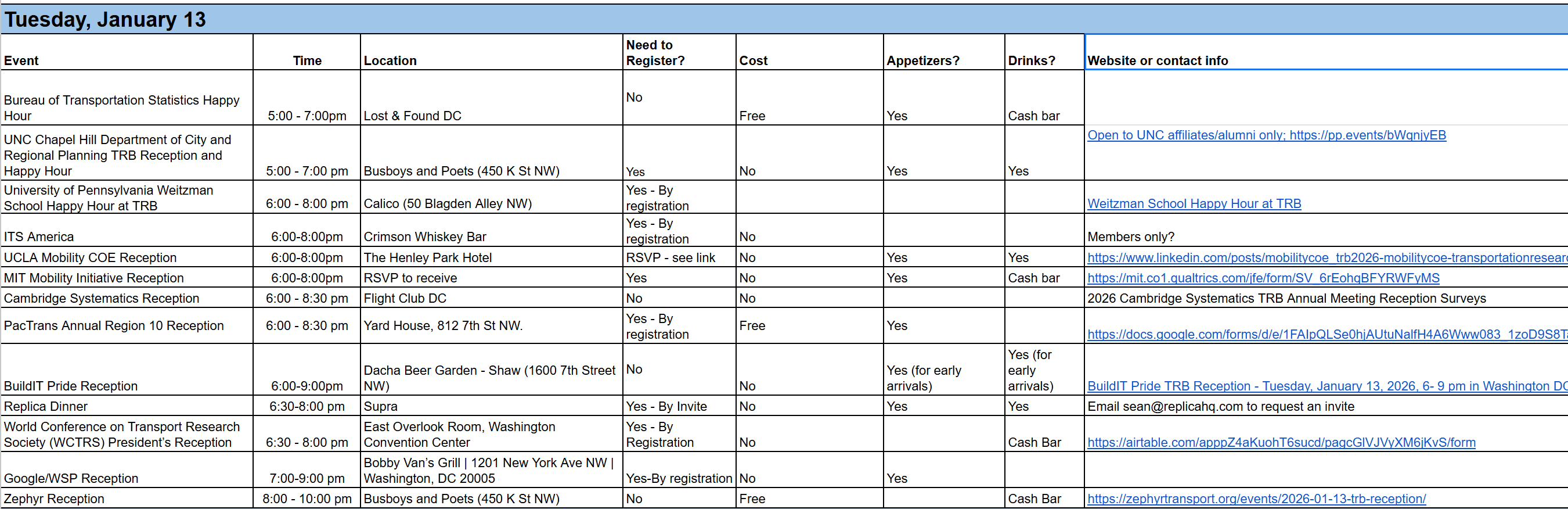
Words of advice, you cannot make all of these and don’t try:
The times often overlap. Most of these run from 6-8.
These are close to one another, but there’s still a walking distance between them and it’s January in Washington.
Focus on quality over quantity. You’re not going to fully advance your career in two hours. Meet people that you like and enjoy learning about what they like. Networking is goofy, but making friends you can work with is not.
DON’T forget to follow up.
Use your email, your LinkedIn, your phone and keep in touch with the people you meet. It is OK to send a text or an email a few days after everyone disperses. Following along is only annoying if you, dear reader, are annoying.
DO take some time to recover.
It’s a whole year until TRB reconvenes in January 2027. So do take the time to relax and recover and then get back to it. Dozens of other conferences to attend this year around the country, so let’s not let it all out at once.
Articles I’ve Been Reading
World-Class American Transit
by Transportation for America

A new report from my alma mater produced by friend of Exasperated Infrastrutures, Corrigan Salerno. The takeaway is clear: we must invest and invest wisely into our nation’s fraying and decaying local and regional transit systems to the tune of $230 billion a year for the next 20 years.
This seems like a lot of money but it amounts to an investment of about $676 a person a yea—all in—to helps us compete with our global counterparts. This assumes no user fees, no debt, no outside funding, private or otherwise. I’m not and this report doesn’t purport to naïveté that this number is remotely possible in our current state of…affairs. But that doesn’t mean we don’t need an honest assessment that accounts for decades of underinvestment.
I’ve been told that a few corrollary reports are coming to measure benefits.
The United States needs fewer bus stops
by Nithin Vejendla for Work in Progress (h/t The Overhead Wire by Jeff Wood once again)
I like this piece and it’s got the duel benefit of making salient points and being well-written. Transit planning and operations is a game of tradeoffs: coverage versus speed, cost versus service, revenue sourcing versus spending, etc. If you can think of one problem, I have a handful of equal and opposite problems that don’t fit neatly into a single tradeoff. This is where good community problem ID comes in. Yes data and map shed analysis is helpful for determining optimal solutions, but our models can’t capture stories on their own. We need it all and Nithin is right.
And, hey, maybe we can recapture some of those dollars to reinvest in our systems. A little here and a little there can make a big difference in the aggregate.
A Recent Writer I’ve Enjoyed
I want to give a shoutout to Andy Boneau, the writer of:

Andy’s just been named the new Director of the Richmond, VA Department of Transportation. We’re a big fan of Andy in this house and wish him all the best of luck as he steps into lead the city into the future.
😏
No relation. The center, located downtown at ~9th St. NW and New York Ave. NW, is named after former Mayor and Mayor-Commissioner, Walter Washington, who held both roles in the 1960s and 70s. Fun fact: DC, still not a State as of 2026, had even less control of its budget and operations until 1975, when it earned the ability to govern its own affairs, to an extent. This is a very contentious topic for residents of DC, who often find themselves imposed upon with taxes and restrictions, but do not have a voting representation in state or above houses of government.
Thanks Sam!
I love the idea of TRB, but also v intimidated by it or anything that heady/academic.