


Warning: Learning Ahead!
I’ve gotten some feedback on early drafts of this essay and want to say a few things up front. There are two learning goals for the following:
Policy development can get unruly, generally, and shrinking the Overton window is a lot easier than widening it ex post facto.
Doing a simple thing, like requiring the intallation of Intelligent Speed Assistance is more complicated than “Thing A happens, Then Thing B.”1
I’m using road safety a a liberal blanket for the way I think about policy. If your response to reading any of the following is: “Nope, you didn’t consider this,” or, “That’s not how this works,” I will have done my job.
The Problem: 40,000 Road Deaths A Year
I’ve known since my first full-time planning job that “planning” on its own is mostly a useless pursuit. The arrogance that humans think they can truly terraform is second only to the lamentation that we think we can optimize it. There’s got to be something else to this because the alternative is chaos. Maybe that’s what humans are predisposed to.
I’ve also known that humans are mostly selfish or self-serving creatures, who, when sat behind a steering wheel, turn into insufferable jerks. So we design our roads, shockingly, to allow arrogant meatbags to drive as fast as they want, and, too often, dozens of thousands of times per year, into each other. And, since we’re also too arrogant to meaningfully redesign the roads we drive on, we spin our national safety wheels round and round.
Road and street redesign should be a national, state, regional, and local investment priority.2 Theoretically, by limiting how, where, and how fast motorists can putt-putt around, we can limit the exposure and potential for traffic violence. Practically, we don’t want to.3 So that’s the end of that, probably.
Even if we could diet every road and GLP-1 every street, no matter what, as long as humans control their vehicles, they’ll drive as fast as possible.4 So what do we do? It’s time to meet the problem at its source: the vehicles themselves. If we have the technology to build these cars, buses, and trucks to drive very fast, then we have the technology to retrofit them with limiters.
The Solution: Speed Limiters / Speed Governors
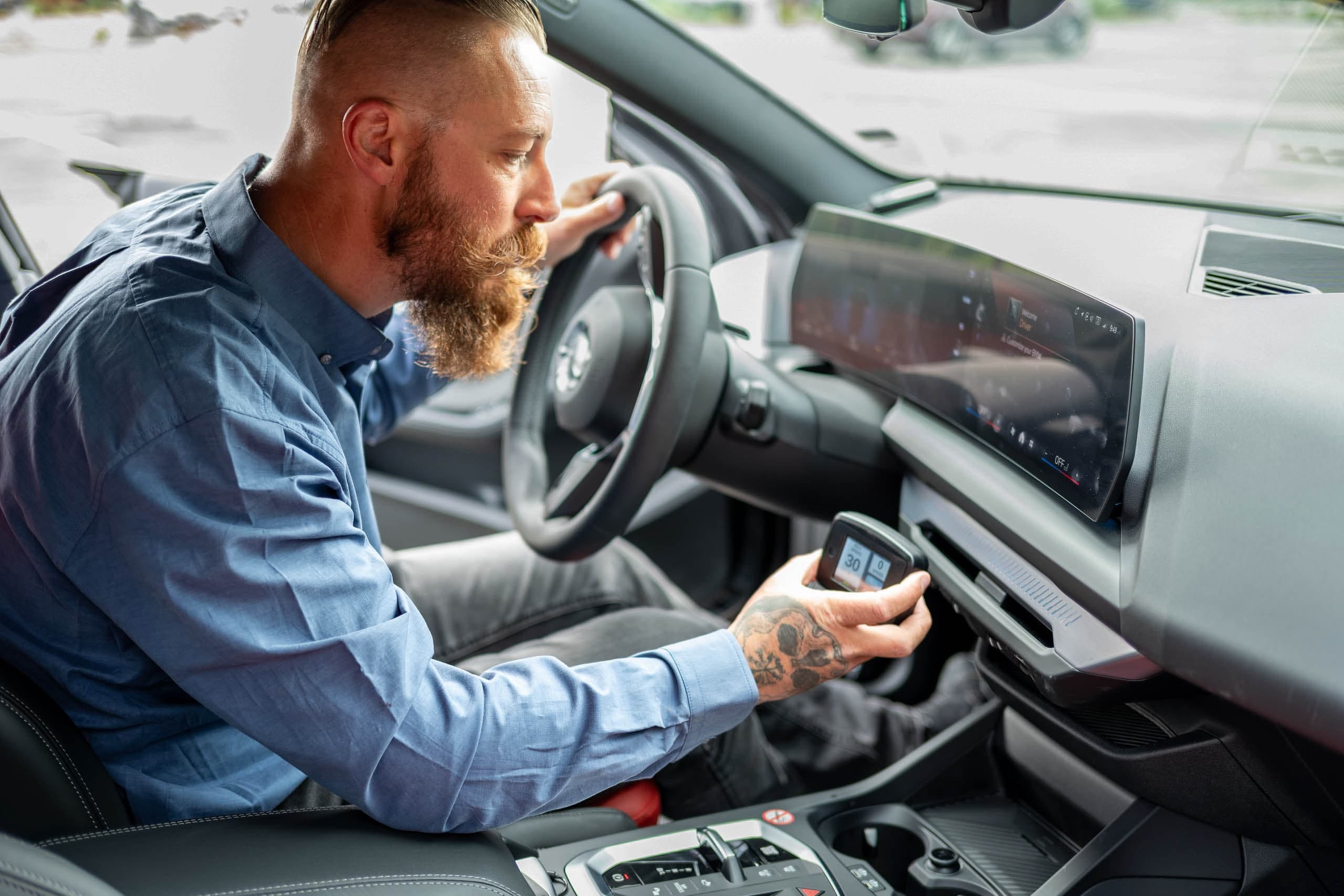
But here’s the question that’s going to drive the rest of this post: how? How do we retrofit millions of vehicles, let alone hundreds of superspeeders—repeat offenders who continuously get caught, charged, and convicted of speeding and or crashing? Who says who a superspeeder is? What does the full chain of enforcement look like?

I’ve non-exhaustively categorized 85 different groups of different stakeholders into 19 sectors, and then additionally into 16 different categories for AVs. Then there are the conflict nodes: the open questions and stakeholders who are naturally and artificially at odds with one another. There’s no way to reconcile them within the structures of government and partnership we currently have. So, there’s really only one way to stop the superspeeders: install an intelligent speeding assistance device. But there arise challenges—solvable—but ones that need thinking through nonetheless.
How To Make Sense of This Ridiculous Chart.
This is a lesson in planning policy and general deep thinking, but more than any other interpretation, this chart is an exercise in accountability. Not every stakeholder will interact with every part of the policy, but since we’re doing…policy planning, let’s, uh, plan for different scenarios, considering the edge cases as completely as possible. We won’t get them all, but that’s where safety cases come in, generally.
For example, just how important is USDOT in setting state speeding policy, which is already, famously managed at the state level? Less than is immediately obvious, but there might be opportunity to organize and reconcile state policies for dissemination and recontextualization.5
Who sets motor vehicle manufacturing standards? NHTSA—an office under USDOT’s purview—is responsible for establishing and maintaining Federal Motor Vehicle Safety Standards. It is their jurisdiction to incorporate a national standard for how ISAs should interact with increasingly technological motor vehicles, and should this standard only apply to newly manufactured motor vehicles? How do we ensure (and insure, I guess) that each driver is subject to the same rules regardless of the car they drive?6
Couldn’t the state just revoke a habitual driver’s license to operate a motor vehicle? I mean, yes. Suspending or revoking the legal right to drive is an option, but:
It does not stop the problem at its source. You can still drive a car without a license. Illegal ≠ impossible.
It deprives a person of the potential to earn a living. Yes, there are other issues here.7
Is there a right to cure? Is it permanent? What’s the punishment besides a speed limiter? Should there be …prison?89
And so on and so forth. I’m giving away the store here. Let’s break it down in steps.
Steps!
Step 1: Understand the problem you’re trying to solve. Don’t assume any salient facts or details. Ask why a lot. Ask who is in the room—and who isn’t.
This is the sandbox you’re going to play in. The power mapping above could be shaped to answer almost any question that you might tease out of it. The list is never fully exhaustive and might misshape who interacts with whom. Chase down hunches here. The more complete your thought process is up front, the easier it is for you to throw up your hands in complete disgust by Step 5.
Step 2: Ask questions (out loud, to your team, a brainstorming board, to God(s)) until you’ve reached the essence of an argument. This step is a lot easier from first principles. Reinterpret the question as a problem statement.
The Question I want to ask here reinterpreted as a Problem:
How do we reduce vehicular speeding? Nope. That’s too broad and too vague.
Where are the conflict points/nodes in a power map for the installation of speed limiters? Closer, but it’s too narrow, and you’ll box yourself in too quickly.
What are speed limiters, and how can they be deployed? I don’t like this one. It’s begging the question. It’s also more definitional and less argumentative—the argument is the thesis behind the why.
Where are there openings to develop policy to reduce average vehicle speeds on our municipal roads and streets within five years? This is better. It asks for specificity and develops a thesis. It also limits spatial and temporal analysis.
Given we like the last question, what does it look like rewritten as a problem statement?
Roadway fatalities continue to oscillate around 40,000 per year despite uneven intervention. Given the expectation of a similar level of investment with similar outcomes over the next Federal cycle, local, regional, state, or Federal policy should seek to address the manufacture and operation of the cars, buses, and trucks to address crashes.
Is this bad? Yes. It’s too wordy and confusing. I like the first sentence, though. How about:
Roadway fatalities continue to oscillate around 40,000 annually despite continued investment in roadway safety across the United States over the past decade. There is ample opportunity to address the manufacture and operation of the vehicles themselves, and policy solutions should seek to leverage local, regional, state, and Federal resources to slow traffic to meaningfully decrease the likelihood of a fatal crash.
Better. But still wrong.
Roadway fatalities continue to oscillate around 40,000 annually despite continued investment in roadway safety initiatives across the United States. If we assume a similar investment pattern through the next decade, ample opportunity exists to reconfigure vehicle manufacturing and operations standards to meaningfully reduce speeds and crashes. In particular, we recommend a policy framework to deploy and monitor speed limiter installation and maintenance where appropriate.
I like this one. It establishes precedent and the challenge as an argument, it connects to and expands upon a deep understanding of how roadway investment works, and it suggests a potential solution. Is it perfect? No. If we were actually writing this white paper (which we might!!!) we’d rework this thesis statement until we hit submit to publish.
Step 3: Power map. Adding stakeholders shapes the box and adds edges. This happens before or concurrently to quantitative (observation, modeling) or qualitative (survey, anecdotal) analysis.
That’s what I’ve done with the linked power map. There are so, so many more stakeholders there than when I first started brainstorming. Mapping often unfolds in a similar pattern, no matter the policy initiative at hand. If you start with a basic wire: public, private, non-profit, or advocate, user, interested bystander, inevitably you’ll find yourself asking (out loud, to God(s), etc.) who else should be here? Who interacts with whom, or, more interestingly, who hasn’t interacted before and how has that manifested elsewhere?
This is where experience plays a role. There are only so many conversations you can have when you’re not invited into a room, and you can’t know what you don’t know. But that’s what I’m here for. Talk to me. Hi. I will be your policy comms guru. It me.
Step 4: Start asking the questions behind the question to tie everyone together. This is where the edge cases come up and completely screw you.
This initiative is not new, but it was new to me when I sat in on a session at a civic tech day sponsored by BetaNYC. It seems like an easy and obvious fix at first: we mostly know who’s caught for speeding the most → speeding is an outsized factor in traffic deaths → children and older adults are more vulnerable to traffic violence → if we can’t redesign our roads and streets to slow everyone down → install speed limiters in the cars themselves to remove the possibility to do violence.
Conceptually sound. Practically impossible. Here are many of the questions that popped up.

How do you build a data protocol to enforce speed limiter installation?
This is the most challenging technical question that seems like it could be easily solved if we (read: vertical and horizontal Federalism) could get it together and standardize data sharing and enforce it. The practical stakeholders in this data chain are the following:
The court system: jurisdiction matters here. Where the infraction occurs matters; if you’re caught speeding (habitually) in Upstate New York or in Manhattan or elsewhere, you’ll be summonsed to that court to be due processed in front of a judge in that courtroom. Each jurisdiction may have its own record-keeping standards. It may store its data as a GeoJSON, or it might literally scan handwritten records into a document. As far as I’m aware, there’s no standard across municipal court systems, as there’s no standard across state lines, or at the Federal level.
Knowing this: The DMV (or RMV) or other licensing body must use or be able to convert court records to licensure language. There must be some way to understand the record of a court decision and how it affects your ability to drive with permission from the state. This is relatively easier than the court data procedure because each state or territory has a single licensing body.
Knowing this: The police or traffic officers must first know what to look for: a conspicuous mark that signifies the licensee as a habitual speeder or a flag for further review. This one isn’t so hard. It requires training and reinforcement—something traffic officers should be engaging in habitually. They must issue a ticket or summons that bumps back to the DMV, the local court system, and the collection agency.
Knowing this: The department of finance in the municipality where the ticket was issued must have a similar protocol to collect the fine. This is not always the case, and there must be a way to cure.10 This, too, shouldn’t be so hard.
Knowing this: if these agencies, authorities, and courts can coordinate, that closes the loop. Speeders get ticketed appropriately, and the municipalities collect fines accordingly. The big problem is the next step toward street safety: installation of a speed limiter.11
Who says who is a habitual speeder? (New York State does)
Whereas there’s a system in place to ticket speeders, it would seem that a good precedent for understanding who is going to speed in the future is…who has been caught speeding in the past. Turns out there’s also a bill that’s crawling through the New York State legislature that will mandate the installation of an Intelligent Speed Assistance (ISA) device in a vehicle registered to a driver who’s been caught speeding SIXTEEN times for a minimum of 12 months following the determination in New York City.12 The bridge policy—how these two points are connected—is to ensure that the state can actually track and confirm 16 infractions before the mandate.13
I have some additional thoughts here, mostly related to interstate commerce and who gets jurisdiction14:
\ practical concerns:
I’ve covered this a little, but there are jurisdictional challenges that are not necessarily relevant until they are. There’s also the ability to install the limiter: the technology has to exist (it does), it needs to be mandated (it can be), and it needs to be actually installed (how?). There’s also the “What happens if you need to override the limiter?” question that mimics the interstate commerce/cross-jurisdictional issue: “How often does this matter enough to have to legislate/mandate an escape from norm?” and the answer is, “Sometimes.”15
Also: what if the person simply uses a different car? What then, smart guy? Sure, they might get caught and punished, but…the point is to stop them.
\ safety, security, privacy concerns
Less important than you might think, but it can and will effectively kill any Good policy. I would argue that the ACLU would have privacy concerns with this insofar as how location data would be handled for monitoring purposes. That’s a lawsuit, or at least a very public complaint whose bona fides would spread virally: this installation is an invasion of one’s privacy, all else equal.
If we would hold privacy concerns equal, there are other concerns about general safety, even though the speed limiter would increase system safety. How could anyone tamper with the device that might actually make a motor vehicle more dangerous to drive? Security, different than safety, as I will endlessly distinguish, is mostly around feeling and being personally safe. Does this limiter make you a target for car theft (no)? Not a concern, really. But important to think through and run the idea into the ground.
\ equity concerns
This is a double-edged sword, as it often is. On one end, overpolicing and deconflicting super speeding from general surveillance. The number of installed limiters should roughly estimate the proportions of the population within a place. COUNTERPOINT: on the other end, what if the most speed-related crashes cluster in communities whose roads/streets have been systemically disinvested or underinvested or Interstated? Don’t crash victims deserve justice? COUNTERPOINT: Lots of crashes don’t occur near where people live or work or travel to, but on the way. Place-based concerns here are mostly moot? But also not? Is this an equity issue?
Blanket device installation would be a desirable outcome to hopefully slow these maniacs down. But then what if people don’t drive their own cars all the time in the future….problem solved?
How does this change in an autonomous future?
If there’s no driver, who is responsible for a crash in an autonomous future? There’s no chance there will be no crashes when the world moves without human operators, but the responsibility and burden/duty of care shift dramatically. What happens when the logic of an external limiter conflicts with the AV’s own internal logic?
You might ask yourself here, why would any government mandate an external limiter for a car whose “speeding” is algorithmic? The answer is they wouldn’t. Nevertheless, there might be an instance at some point where this is a pressing challenge, and having the option to mandate a third-party (government) intervention is a desirable outcome. We just don’t know.16
We do know that there’s more to the bumpy transition to an autonomous or robotic future. I’m most interested in the developing body of tort law that distinguishes between driver liability and product liability. The stakeholder map elucidates who could be influential in writing future legislation or who might be friend/enemy to the court in litigation.
Step 5: Exasperation Ensues

Something, something, post hoc, ergo propter hoc.
I want to make it clear here, especially to my most localpilled friends and colleagues, that yes, most of these infractions happen on locally-controlled roads, but many localities don’t have authority or other ability to mandate much more than spending money to plan or construct safer streets. This is not the focus of this article, but there is a large part to play from local enforcement agencies.
This isn’t totally true, because the Federal government still funds Safe Streets for All (SS4A) grants for hundreds of communities, but it feels true because we need thousands and thousands more.
I’m distinguishing between as fast as possible and dangerously fast. No* driver buckles up with the intent to kill, necessarily, but they will anyway.
*I think it’s also impossible to say “no driver.”
I am overindexing on cross-jurisdictional borders that mostly affect driver movements on the East Coast, and more specifically, the regional boundary among New York, New Jersey, and Connecticut (and I guess, Pennsylvania). If the affected car is registered in New York, and the superspeeder law is only enforceable in New York, would a New Jersey traffic violation add to the count? Is the ISA enforceable outside state lines?
I am sure there’s precedent here because if I’m crashing out in a footnote on a blog post about this, surely someone’s thought of this already. I don’t want to get too deep into the technical…No, I went to look at the law, and it’s hundreds of pages of specification. The point here is that if there’s any rule not positively stated and a question arises about how to manufacture a vehicle that could have a speed limiter installed, then how does the law require it, especially if the law is not nationwide.
The only reason we can reasonably be sure that OEMs and big car manufacturers are building safe cars is our joint belief that every manufacturer and parts provider is building cars to the minimum safety standard. This is …a lot.
Like: if a habitual speeder crashes and kills another person/driver, how is that not deprivation of ability to uh, earn a living? Why is the speeder’s freedom more important than the potential victim's?
That would require any state to treat traffic violence at a similar standard to…any other violence. Why is killing someone with your vehicle—that you’re supposed to be responsible for—different than any other murder with a deadly weapon? When did we decide 40,000 deaths a year was an appropriate price for someone else to pay for beep beep crash boom fast drive!?*
*No one outwardly decided this, but it is the social and often legal norm. Kill someone with your car? Suspended sentence!†
†Which is bullshit. Okay, now that I’m three footnotes deep: just because a crash wasn’t necessarily the driver’s fault, doesn’t mean the driver wasn’t responsible for it. Drivers do not want to look at the world through this lens, so what you, dear planner, three footnotes deep, get is general anger at the suggestion that they should be extremely responsible for the operation of their 3,000-pound metal death machine that happens to zoom vroom move fast to work.
Also, I’m generally against prison as a punishment (read Foucault loser), but what’s the final retribution for posing an imminent threat to the general public?
Generally, this is true. Think of this as the if…else statement for policymaking. What happens if there’s a loose end or edge case?
If you’re thinking to yourself, we have the technology for this vis-à-vis vehicle technology, the answer is yes. There’s precedent here—over 7,000 NYC municipal vehicles already have these installed.
This inititiave was included in NY State’s final budget and only authorizes NYC to require the installation of these devices. There’s a provision to pilot this program outside the city, but for now there’s a water’s edge.
Curious: Will the infraction be when it occurred or when the courts say so? This could temporally shift the “year” timeframe…but do we assume that these speeders won’t just keep speeding? Inertia, etc.?
I’ve been told and assured that this is a red herring argument because the practical implication of a lack of Federal rule for super speeders is diminishingly impactful. My point is this: there’s a practical reading of the law, and there’s also a complete reading that will, at some point, come up in the discussion of “…but what if?” and if it happens. You’re here for the exasperation; just go with it.
Which is unsatisfying, but that’s policy, baby!!!
Or maybe we do. I’m confident enough to say I don’t know.
I'm your new biggest fan. In the interest of classical skepticism: What if speed *is the product that carmakers sell*? All of the gains in fuel economy in the power train have been eaten up by more powerful vehicles -- watch any car ad and its clear that they're selling rapid acceleration and huge horsepower.
So to the degree that the United States is just a car company with a sideline in medicaid and national defense, I think the idea of regulating Detroit is a lost cause. They control the federal government at every turn. Street re-engineering is both democratically executable, and probably the only way to achieve the goal.
i like the way you've framed the US as a car company with a side of medical debt and bombs.
we have a CULTURAL challenge that we're trying to match with a LEGAL framework, when the answer is probably more toward ENGINEERING with a bit of SCIENTIFIC METHOD.
thanks for being a fan (please share this widely!)